At some point, the bluff will need to be called.
Russia’s vicious invasion of Ukraine has fallen far short of the Kremlin’s objectives. However, that has not changed Russian dictator Vladimir Putin’s desire to subjugate Ukraine, destroy Ukraine’s democracy, seize territory, and eliminate Ukraine’s ability to defend against future invasions.
That last point is the key reason Russia opposes Ukraine’s accession to NATO. Russia knows NATO poses no offensive threat to Russia. Instead, NATO ‘threatens’ Russia by making it far more difficult for Russia to invade other nations. For example, without NATO membership, Estonia, Latvia, and Lithuania would all likely have been invaded by Russia already, perhaps through the ‘little green men‘ strategy Russia employed in Eastern Ukraine. Poland would also find itself at risk.
Meanwhile, there is zero chance that any of those nations – or any other NATO country – will invade Russia, and Russia knows this. In fact, Russia has significantly reduced the number of troops currently bordering NATO countries in order to pour more forces into Ukraine. Much of Russia lies wide open if NATO troops wanted to walk in, which they of course do not.
I mention this because it is key to countering Russian misinformation about NATO, and about the prospect of Ukraine in NATO. When Russia says it feels ‘threatened,’ it means it worries it won’t be able to launch brutal invasions of independent nations.
And that brings us to Russia’s response to the prospect of Western troops, planes, and ships protecting Ukraine following a ceasefire/peace deal:
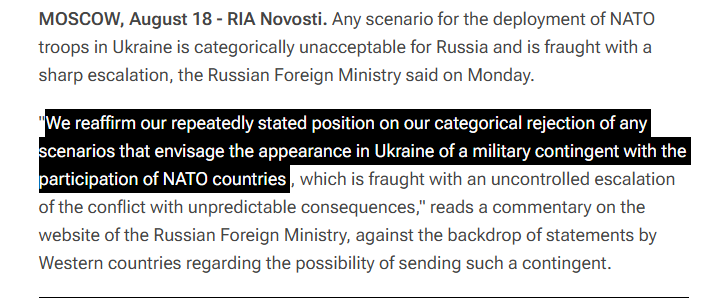
Russia knows that the presence of troops from NATO countries in Ukraine (not the same as an official NATO presence in Ukraine) would make another invasion nearly impossible. Were Russia to strike Ukraine following a peace deal, it would face the prospect of attacking military personnel from countries like the United Kingdom, France, Germany, Italy, Canada, and potentially the United States. That would lead to a response that would almost certainly halt any further Russian aggression. Knowing this, Russia would be hesitant to attack Ukraine again in the first place, just as Russia is hesitant to attack countries like Latvia (where Canada currently has troops stationed), Estonia, and Lithuania, despite being stronger than those countries on a one-on-one basis.
Call the bluff
Thus, the Western world needs to prepare to call Russia’s bluff. In advance of any deployment of a reassurance force as a post ceasefire/peace deal deployment, Russia would almost certainly threaten nuclear war, “World War Three,” and strikes against Western capitals. They will do everything they can to raise the level of fear and try to scare Western nations away from deploying forces in Ukraine.
Unless we wish to live in a world where Russia can use nuclear threats to dictate to other nations, the bluff will have to be called and troops, planes, and ships will need to be deployed into Ukrainian territory despite Russian objections. The West will have to show backbone and make it clear that Ukraine and Ukraine’s allies – not Russia – get to decide on the deployment of forces into Ukrainian territory.
Spencer Fernando
Image – YouTube
Subscribe to my Substack, where I create more content for a strong and sovereign Canada.
Prefer a one-time contribution? You can give via PayPal.