With immigration becoming a topic of increasing discussion in Parliament, a new PBO report indicates Canada’s population growth is set to remain subdued going forward.
A new report from the Parliamentary Budget Officer indicates the government is on pace to hit its target of reducing the non-permanent resident share of the Canadian population to under 5% by the end of 2027. Further, population growth is set to remain flat in 2026, before rising slightly to 0.3% in 2027. The long-term trend is for population growth of about 0.8% per year, lower than Canada’s pre-2015 historical average of 1.1% per year.
Here are the details.
As you can see in the chart below, the significant influx of non-permanent immigrants has reversed. This, combined with a decline in net permanent immigration and a lower natural increase in the population, has resulted in population growth dropping below the historic average:
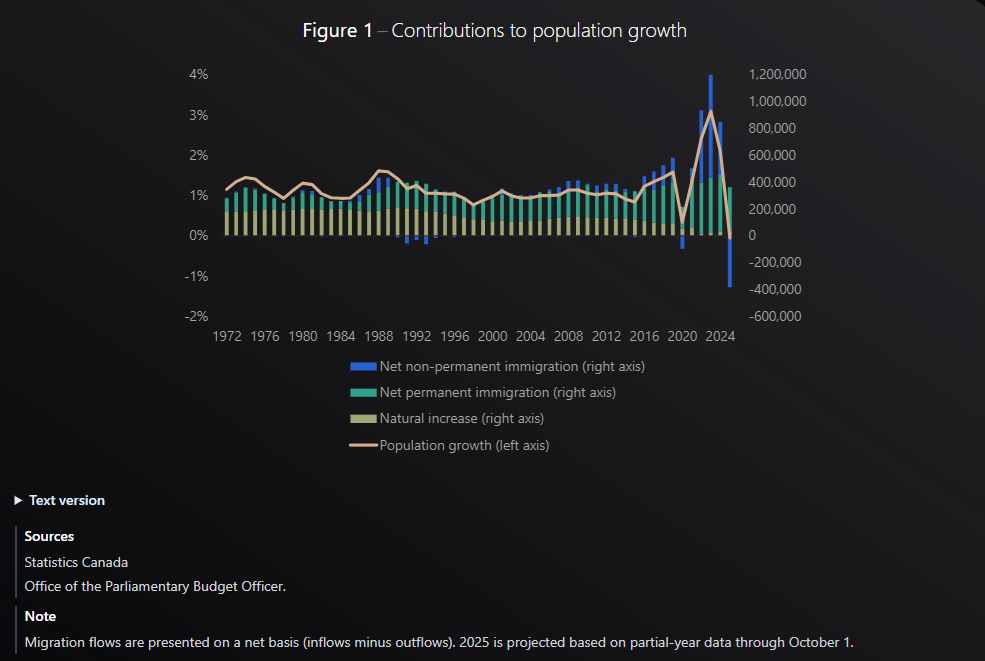
Regarding permanent immigration, a significant portion (48%) of the ‘inflow’ of permanent residents in 2025 was not new immigrants coming to Canada, but rather non-permanent residents (students/temporary workers) becoming permanent residents, meaning no net increase in population in those instances.
There is also a shift in the makeup of the non-permanent resident population. Amid significant declines in the international student population and declines in the temporary foreign worker population, the number of asylum seekers and protected persons has increased to a record high of 500,000 by Q3 of 2025. However, given that individuals in that category represent just 18% of non-permanent residents, that increase has been more than outweighed by the decrease in the international student (50% reduction) and temporary worker population.
The government has also announced two initiatives that – as noted above – will shift some temporary residents to permanent status. 115,000 people with protected person status and their dependents already living in Canada, as well as 33,000 temporary workers who have strong roots in their communities. On paper, this will increase the permanent resident ‘influx’ over the next two years, but represents people already in Canada shifting status, not a net increase in people coming to Canada.
A return to Harper-era immigration levels?
From 2006 to 2016, the share of temporary foreign workers in Canada as a percentage of the population rose from 1.6% to 2.6%. From 2016 to 2024, that number rose to a peak of 7.5%, before dropping to 6.6% in 2025. With the government on track to stabilize the TFW population at 5%, the long-running upward trend in the TFW share of the population will be halted and stabilize above the historical norm. However, given the aging of the population and lower natural population increase, combined with a reduced temporary resident intake and stabilized permanent resident numbers, population growth is set to stabilize around 0.8% per year, below the pre-2015 historical average of 1.1%.
Thus, Canada is returning to something reminiscent of Harper era immigration levels – as a percentage of the population – and subdued long-term population growth, albeit from a higher population base due to the 2022-2024 increase. This is important to note, given that much of the current political debate on immigration is built on assuming the 2022-2024 yearly increases are occurring, when the reality is that immigration has been significantly reduced, population growth is currently near zero or even negative, and the long-term trend is for growth below Canada’s historical average.
Spencer Fernando
If you would like to support my work in defence of the truth and a strong and sovereign Canada, please consider making a contribution through PayPal at the button below:

Alternatively, if you would like to support my pro-Canada perspective on an ongoing basis and gain access to exclusive content, you can subscribe for $6 a month or $72 a year.
Subscribe here.
Subscribe to my Substack, where I create more content for a strong and sovereign Canada.
Prefer a one-time contribution? You can give via PayPal.