The Q4 decline is less than ideal; however, the economy grew in December, and per capita GDP is up for the year, indicating a return to per-person output growth following years of GDP increases driven by population expansion alone.
With the release of Statistics Canada’s December 2025 GDP numbers, we now have a complete picture of Canada’s economic growth both in Q4 of last year and last year as a whole. Let’s take a deep dive into the numbers and their implications for Canada’s economy and standard of living.
To start, Canada’s GDP declined 0.6% on an annualized basis in Q4 of 2025, compared with a gain of 2.4% in Q3. The decrease was driven by withdrawals in business inventories that had largely been accumulated in Q2 and Q3. The manufacturing sector was down 1.5%, with machinery, wood products, transportation equipment, and fabricated metal product manufacturing dropping by 6.6%, 6.2%, 2.2%, and 3.2%, respectively. Educational services dropped 1.7% (due mostly to a teachers’ strike in Alberta). Wholesale trade dropped 1.4%. On the growth side, healthcare/social assistance and public administration rose 0.7% and 0.5%.
A return to growth in December
On the positive side, Canada finished the year with 0.2% GDP growth in December. Manufacturing helped lead the way with growth of 1.2%, after dropping in October and November. Machinery manufacturing rose 6.6%, non-metallic mineral product manufacturing rose 5.2%, electronic product manufacturing rose 4.1%, miscellaneous manufacturing rose 7.4%, and auto manufacturing rose 5.8%. Vehicle parts manufacturing and motor vehicle body and trailer manufacturing were down 3.7% and 3.5%, respectively.
Canada’s wholesale trade rose 1.7% in December, while the public sector and transportation/warehousing sector grew 0.2% and 0.7%, respectively.
Canada’s economy grew 1.7% in 2025
Despite the Q4 decline, Canada’s economy grew 1.7% in 2025. While this was the lowest rate of growth since the pandemic-related 2020 recession, it indicates underlying resilience in the Canadian economy amid U.S. tariffs and ongoing trade disruptions – disruptions that can make long-term business planning and investment decisions far more difficult. And – in a point we will look at in-depth later in this piece – this growth came amid near-zero or even negative population growth, a stark change from recent years.
For the year, exports were down 1.7% (largely due to lower exports to the United States as a result of U.S. tariffs on Canadian goods), and imports were down 0.4%, driven by the 2.9% decline in Q3. Of note, exports rose 1.5% in Q4, up from a 0.9% increase in Q3, while imports rose 0.3% in Q4.
Household spending rose 0.4% in Q4, following a 0.2% decline in Q3 of 2025. Of concern, however, is that this growth was driven by increased spending on rent and financial services, while spending on new passenger vehicles and alcoholic beverages led declines in spending on goods. This indicates the ongoing affordability challenges facing many Canadians, and while this spending does technically count as growth, it is not experienced as growth for many.
The household net saving rate was 4.4% in Q4, down from 5.2% in Q3. For the year, the household net saving rate was 4.9%, in line with 2024.
A boost from rearmament
As I have previously noted, Canada’s long-term lack of military spending represented a source of potential economic growth that many countries take advantage of more effectively. There are signs that Canada is starting to move in the right direction in that regard. In 2025, capital investment rose 1.4% overall. This was driven in large part by a 45.9% increase in government investment in weapons systems, along with a 6.7% increase in engineering structures. Overall, business investment rose 0.3% for the year. As noted by Statistics Canada, “The year 2025 was the third consecutive year in which government capital investment contributed more to GDP growth than business capital expenditures,” an indication that Canada remains quite dependent on government investment for growth.
With Canada continuing to raise military spending, the economy should continue to get a boost from the growing defence sector. If this is combined with increased military research and development funding (as the government has promised in the recently-released Defence Industrial Strategy), the long-term benefit to the Canadian economy could be significant and could continue to grow in the coming years.
Wages up 3.9%
For the year, employee compensation rose 3.9% (up 0.5% in Q4). While this was the lowest increase since 2016 (excluding 2020), it comes amid lower inflation, meaning a small – but real – increase in purchasing power.
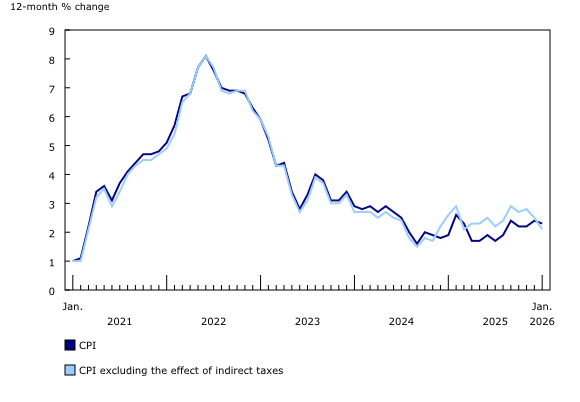
For the year, wage growth was highest in provincial & territorial administration, and health care & social services, which were up 7.6% and 6.9% respectively.
Essential context: A halt to population-driven economic growth
For those looking to score political points based on this GDP report, the key area of focus will be the fact that 1.7% yearly GDP growth is the lowest since 2020. That is true. However, there is an essential context to this number that should not be overlooked: Canada’s population growth has halted. As you can see in the chart below from the Parliamentary Budget Officer, Canada’s population growth is now negative:
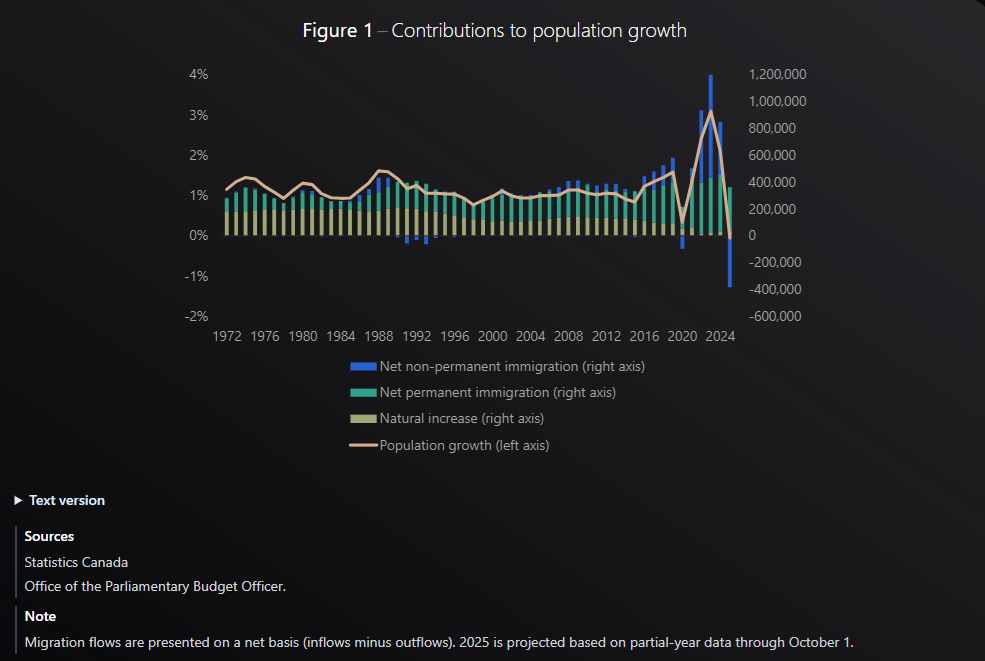
What this means is that Canada is no longer using large population inflows to generate GDP growth. The large influx of people between 2021 and 2024 made it ‘easy’ for Canada to generate economic growth. Bringing more people to a country will generally mean more overall economic activity. However, when the influx of people is higher than an economy’s ability to efficiently absorb the influx, and when social services are put under increasing strain, the increased economic activity may not match the overall increase in the population. Thus, while there may be more overall economic activity, there will be less economic activity on a per capita basis. That has been the case in Canada over much of the past half-decade, as our per capita GDP first stagnated and then went into outright decline. This has been a key contributor to the sense that many Canadians have that we are ‘getting poorer.’ That sense was correct, because – in per capita terms – our economy was shrinking even if it grew overall.
In that context, 1.7% GDP growth amid a declining/stagnant population is notable. Canada is now generating real per capita GDP growth, which also means our productivity should continue to increase. As noted by RBC Economics, 2025 represented Canada’s first annual increase in per capita GDP in three years:
“On a per-capita basis (controlling for a sharp slowing in population growth following federal government immigration caps) GDP growth actually accelerated in 2025, posting its first annual increase in three years (+1.1% by our count following 0.7% and 0.9% declines in 2024 and 2023, respectively).”
The final count of Canada’s population shift in 2025 (Q4 population numbers are not yet out) will determine the extent of the per capita GDP gain. But this is an important indication that Canada is returning to the kind of economic growth that makes our economy more efficient and brings tangible economic progress for Canadians, rather than simply growing the topline number while more and more people fall behind.
The Canada-US comparison, and why deficits cannot be ignored
As you read about Canada’s 2025 GDP growth, you will likely come across comparisons between Canadian and US economic growth. For the year, the U.S. economy grew 2.2%, down from 2.8% in 2024. While U.S. growth outpaced Canadian growth, the issue of budget deficits cannot be ignored here. The U.S. is currently projected to run a budget deficit of USD $1.9 trillion (6.2% of GDP). Canada is projected to run a deficit of $78.3 billion (2.5% of GDP). Thus, Canada’s growth is less deficit-dependent than current U.S. growth. This is not to say that Canada’s deficit situation is ideal, but to point out that it is wise to keep the divergent deficits in mind when comparing growth in the two countries. Further, it is important to note that current U.S. deficit projections were based in part on anticipated tariff revenues that may now be lower than projected following the U.S. Supreme Court ruling striking down a large portion of the Trump Administration’s tariff agenda.
Canadian economic resilience
For Canada’s economy to grow 1.7% amid threats of annexation, the imposition of tariffs, ongoing instability caused by a more chaotic world, and a complete reversal of a population-driven economic growth strategy is something that should not be dismissed. Wage growth is outpacing inflation, per capita GDP is up, and our modest level of growth is coming from productivity increases rather than a population influx. The Canadian economy is demonstrating significant resilience, and this is before the full benefits of closer trade ties with other nations, ongoing defence spending increases, and a more pro-energy federal government are fully realized. This is not to dismiss Canada’s real challenges, particularly the ongoing cost-of-living crisis facing many Canadians. Nor should we pretend that 1.7% growth is a great number. But when looked at in the overall context of the times we find ourselves in, Canada’s 2025 economic performance is a solid foundation to build upon.
Spencer Fernando
SUPPORT INDEPENDENT CANADIAN ANALYSIS
Spencer Fernando is funded entirely by readers – no corporate backing, no party affiliation, just Canadians who want clear, honest analysis of what’s happening to their country.
Full access to SpencerFernando.com is $6/month: daily analysis on Canadian sovereignty, trade, politics, and foreign policy, with no ads and no agenda.
If you find this work useful, consider subscribing. Cancel anytime.
Subscribe here.
On Patreon, I create more content for a strong and sovereign Canada.
Prefer a one-time contribution? You can give via PayPal.