It’s the best plane available, and many Canadian companies are part of the F-35 production cycle.
The Canadian Government is currently reviewing the proposed purchase of 88 fifth-generation F-35 fighter jets.
The review was ordered by Prime Minister Mark Carney following annexationist rhetoric from U.S. President Donald Trump, as a way to signal Canada’s opposition to such rhetoric, showcase our strategic sovereignty, and build leverage for future trade negotiations (many U.S. trading partners have offerred large purchases of U.S. military hardware as ‘concessions’ to secure a deal).
With the review likely to conclude soon, Defence Minister David McGuinty has said the government will follow the lead of the military in making its ultimate decision:
“When the review is completed, we can take our lead from the experts that performed the review both in the Department of National Defence and the Canadian Armed Forces,” McGuinty told journalists. “Obviously it would be strange if they didn’t look at the operational needs going forward, and I’m sure they’ll have a lot more to say about that.”
Reuters news service reported Aug. 7 that the Canadian military was recommending that Canada stick with its proposed purchase of 88 U.S.-built F-35s. That recommendation didn’t come as a surprise for observers since the Canadian Forces originally lobbied for and selected the American fighter jet.”
The CAF wants the F-35 because it is the best plane available. No NATO country is currently building a better fighter jet, and the F-22 – one of the few aircraft that might exceed the F-35 in capability – is no longer in production and was never exported by the US to allied nations.
The F-35 has proven itself against Iran, as Israel deployed it against Iran’s Russian-made air defence systems, the same air defence systems NATO is likely to face in Europe. As noted by Admiral Sir Tony Radakin, the United Kingdom’s Chief of Defence Staff, in a lecture at the Royal United Services Institute, Israel’s use of the F-35 showcased the power of fifth-generation fighters:
“Every military needs an edge. That’s how you defeat an enemy. In this sense, Russia is showing us how not to fight. And Israel, in its response to Iran, has shown us the disproportionate advantage of modern ways of fighting.
I won’t go into detail, but in October’s retaliatory strikes again Iran, Israel used more than 100 aircraft, carrying fewer than 100 munitions, and with no aircraft getting within 100 miles of the target in the first wave, and that took down nearly the entirety of Iran’s air defence system. It has destroyed Iran’s ability to produce ballistic missiles for a year, and left Tehran with a strategic dilemma in how it responds. That is the power of 5th generation aircraft, combined with exquisite targeting and extraordinary intelligence. And that was all delivered from a single sortie!”
Israel’s destruction of Iran’s air defences paved the way for 2025 strikes against the Iranian regime’s nuclear program. The Iranian regime bet heavily on Russian air defence systems like the S-300, but that bet did not pay off. Given that the most likely theatre of operations for Canadian combat jets is in Europe, defending NATO allies against potential Russian aggression, it makes sense to use a plane that has proven itself against the kind of defences Russia will field against NATO air power.
Quarterback of the skies
The F-35 is often referred to as the “quarterback of the skies,” due to its ability to collect, process, and distribute vast amounts of information to other allied aircraft, helping 4th-generation fighters perform at a higher level by giving them access to information their sensors and computers wouldn’t otherwise be able to gather and manage. The advanced capabilities of the F-35 also eases the strain on pilots:
“Tony “Brick” Wilson, who served in the U.S. Navy for 25 years prior to joining Lockheed Martin as a test pilot, has flown over 20 different aircraft, from helicopters to the U-2 spy plane and even a Russian MiG-15. According to him, the F-35 is—by far—the easiest aircraft to fly that he’s come across.
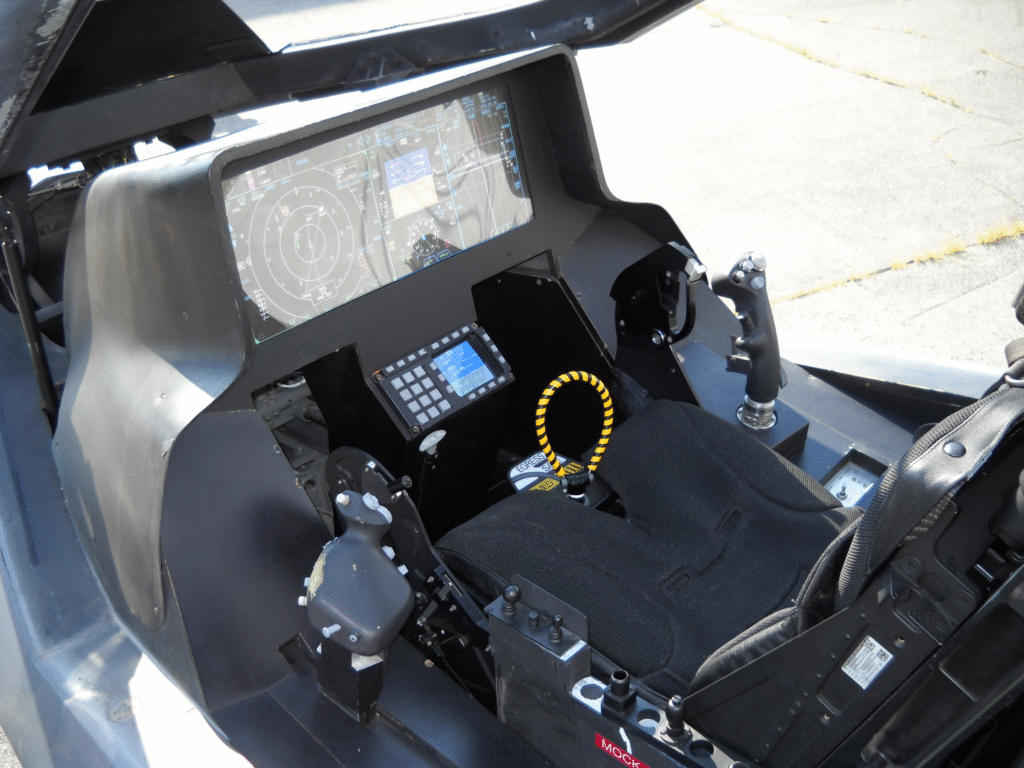
“As we moved into fourth-generation fighters like the F-16, we moved from being pilots to being sensor managers,” Wilson says. “Now, with the F-35, sensor fusion allows us to take some of that sensor management responsibility off the pilot’s hands, allowing us to be true tacticians.”
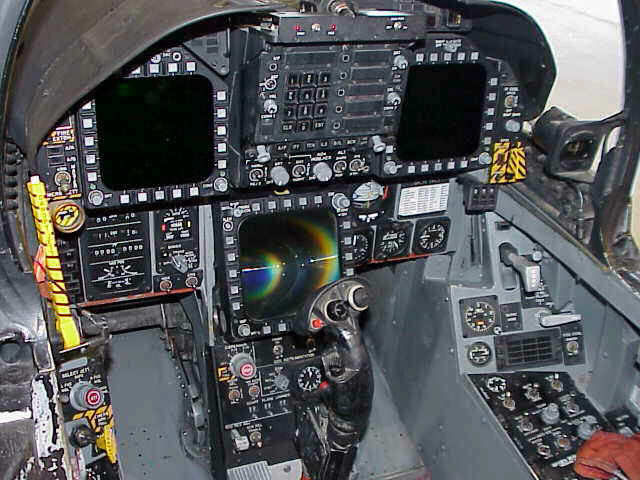
To get a sense of the difference, consider the cockpit of an F-18 (Canada currently operates CF-18s as our main fighter), compared to the cockpit of an F-35:
F-18
F-35
The unique helmet used by F-35 pilots also provides much of the information they need directly through the helmet display, reducing the cognitive load on pilots:
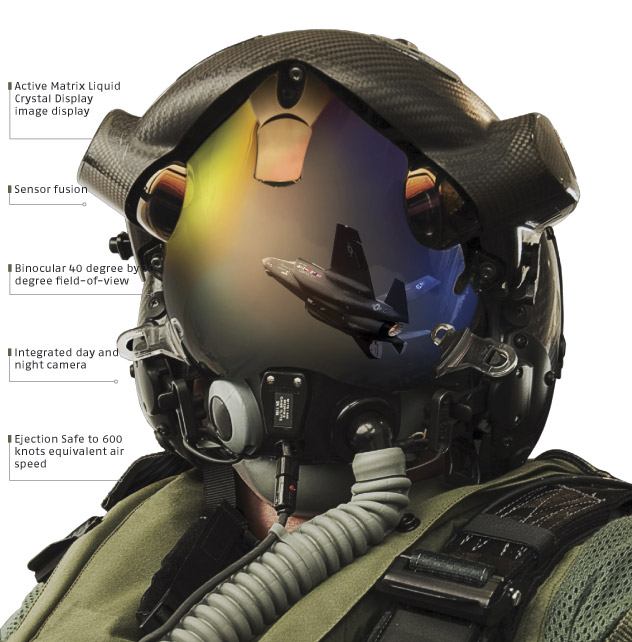
As noted by Arthur De Ruiter of Collins Aerospace, the F-35 helmet provides significant situational awareness to pilots:
“The F-35 helmet and visor system is truly an engineering marvel that represents today’s fifth-generation warfighter. The key difference between the F-35 helmet and a traditional fourth-generation warfighter helmet used on the F-16 is that all the flight and mission data is presented to the pilot on a display, mounted to the helmet.
In addition, the helmet is connected to six infrared cameras located around the aircraft, providing a 360-degree view and unprecedented situational awareness. If the pilot looks around in certain conditions, they don’t see the cockpit or even their legs. All they see are their surroundings like terrain, with the flight critical and mission data projected inside the helmet.”
Stealth
In addition to collecting information and easing the cognitive load for pilots, the F-35 is a significantly more survivable aircraft, thanks to its stealth characteristics and resulting low radar cross-section. As you can see below, it shows up as much smaller on radar than the fourth-generation F-16, despite the F-16 being a smaller aircraft:
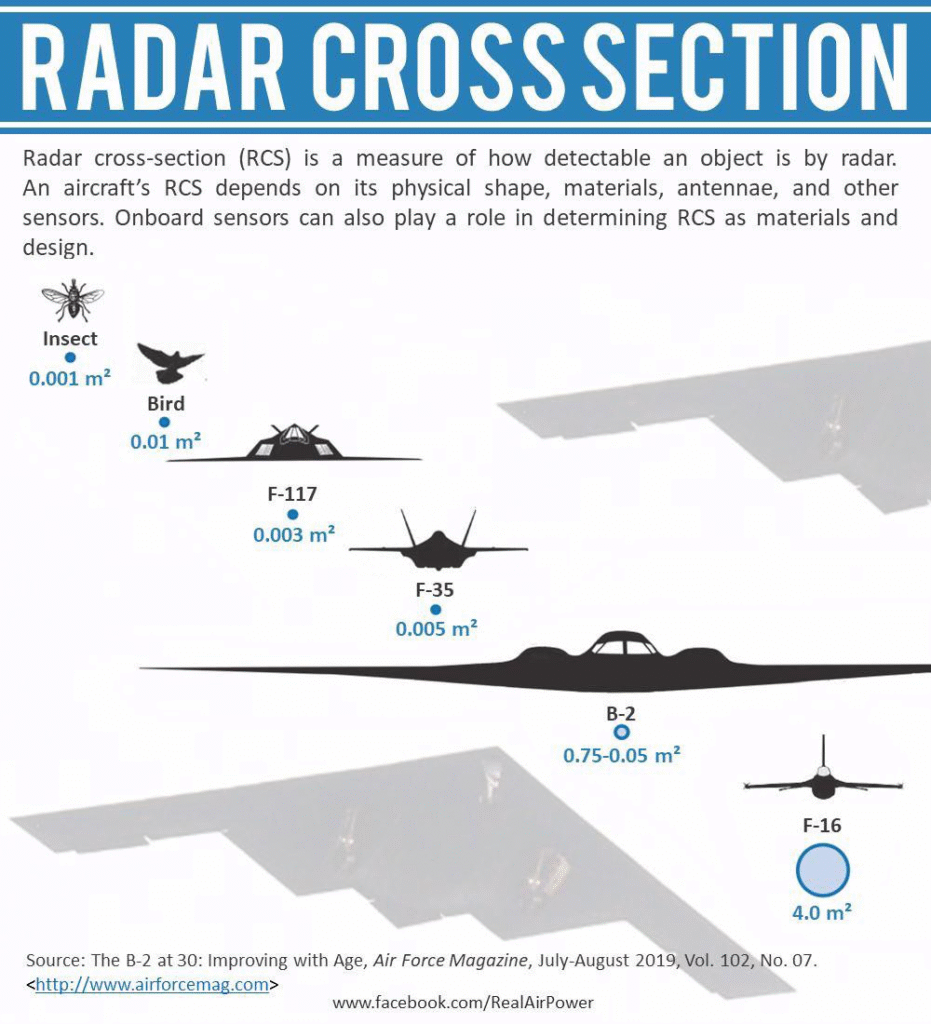
This increased survivability means the aircraft can get in and out of contested airspace without being spotted by enemy planes and anti-air systems, raising the odds of pilot survival and mission success.
NATO integration
It is exceedingly unlikely that Canada will find itself in a major war without allies at our side. While it is technically possible, and while we must ramp up our domestic defence industry to ensure we could survive on our own in a conflict if necessary, the most likely scenario is that Canada’s fighter jets will be operating alongside NATO allies in Europe and the Arctic.
With that in mind, the fact that many of our NATO allies have already purchased F-35s and are awaiting delivery of even more in the future is a strong argument in favour of buying the aircraft.
The F-35 is currently operated by or planned to be operated by Belgium, the Czech Republic, Denmark, Finland, Germany, Greece, Israel, Italy, Japan, the Netherlands, Norway, Poland, Romania, Singapore, South Korea, Switzerland, the United Kingdom, and the United States, most of whom are NATO allies.
Given the powerful sensor fusion capabilities noted earlier, Canada would be well-served by operating planes that are on par with those of our allies.
Canadian contribution
One of the legitimate criticisms of purchasing the F-35 is that it could deepen our dependence on the United States, given that the U.S. maintains control of spare parts and software updates for the aircraft. However, this is true for all countries that have purchased or are set to purchase the F-35. Were the U.S. to cripple an ally’s F-35s, the damage to the U.S. defence sector, trust in the U.S. (already declining), and U.S. credibility would be significant. Further, given that Canada would be using F-35s alongside the U.S. in protecting North American airspace, and given that we would likely deploy the F-35 in Europe alongside European allies operating the aircraft, it is unlikely we would find ourselves in a position where any NATO country would see its planes crippled.
It should also be noted that while the F-35 is an American-made plane, many Canadian companies play a role in the construction of the aircraft.
As noted by Wings Magazine, the F-35 project could generate $23 billion annually for Canadians and sustain 5,000 jobs in this country.
So far, the Canadian Government notes that there are over “30 active contractors in Canada” participating in “manufacturing and services for the global F-35 fleet,” and “over $3.3 billion USD in contracts have been awarded to Canadian industry for the development and production of the F-35,” with further opportunities expected in “airframe and engine depots, training and in maintaince components over the life of the fleet.”
A key example of this is Magellan Aerospace, a Canadian firm that produces horizontal tail assemblies for the F-35A at its plant in Winnipeg.
Participating in the manufacturing and maintenance of an advanced fifth-generation fighter builds the kind of experience and capability Canada needs to help our aerospace sector compete.
Medium-term strength, long-term capability
In the short term, Canada’s fighter jet fleet is in a terrible position. The CF-18s should have been replaced and scrapped a decade ago, and we should already have a fleet of F-35s. But the past cannot be changed, so the best we can do is get things right from now and move forward.
In that spirit, purchasing the F-35 is the best move to ensure Canada has a robust air force in the medium term. With all jets set to be purchased by 2032, and the earliest being ready to fly (including pilot training time) by 2028, Canada could be operating some fifth-generation fighters within 3 years.
In the interim, we should be ramping up our domestic drone industry (in cooperation with Ukraine), as well as expanding our air defence capabilities, to at least recreate in aggregate the tactical air power and air combat power that we currently lack due to the obsolescence of the CF-18s.
In the long term, however, we should reduce our reliance on U.S. combat systems by diversifying our military industrial partners and building more domestic capability. The two best ways to do this would be to join the GCAP program and take up SAAB on its offer to build Gripen-E fighter jets in Canada. Participating directly in a sixth-generation fighter program and building modern fighter jets in Canada would be beneficial to Canada’s aerospace sector and give us more strategic independence.
Ultimately, our country must view the evolution of our fighter jet fleet along three time horizons. In the short term (2025-2030), the goal should be to finalize the purchase of F-35s, sign a deal with SAAB, and join the GCAP program, while mitigating our current vulnerability in the air through mass production of drones and expanded air defences.
In the medium-term (2030-2035), we should replace our CF-18 fleet with F-35s and some Gripen E’s to fully modernize our air force, while utilizing the F-35 program, domestic Gripen production, and GCAP to build a more independent and advanced military aerospace sector in Canada.
In the long-term (2035 onward), we should begin supplementing our then-existing F-35/Gripen fleet with GCAP aircraft (some produced in Canada) and advanced domestically-produced collaborative combat aircraft.
The end goal should be for Canada to have one of the world’s best-equipped air forces and a robust domestic capacity to produce sixth-generation fighters and advanced drones in partnership with a wide range of allies, thus reducing our dependence on the United States and enhancing our sovereignty and military strength.
Spencer Fernando
Subscribe to my Substack, where I create more content for a strong and sovereign Canada.
Prefer a one-time contribution? You can give via PayPal.