In the Second World War strategy game Hearts of Iron IV, countries have ‘national focuses.’ Picking a focus costs uses up ‘political power,’ and brings certain benefits/changes after a period of time.
When playing as France in the 1936 start, your nation faces internal political division that slows the accumulation of political power. Further, the military is short of top-tier equipment, short of basic equipment overall, and the economy is stagnant. As a result, in the scenario – just as they did in real life – France needs time to build up its strength in the face of a rapidly crumbling global order.
One of the main focuses for France – if playing in a somewhat historical (though optimized) manner – is ‘Buy Time’:
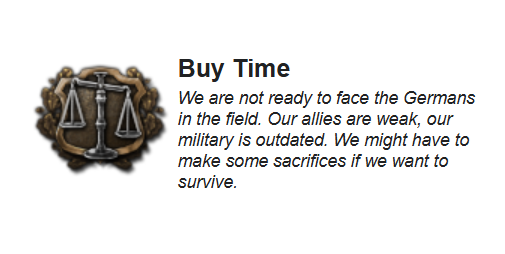
In the French context, buying time means rescinding guarantees to countries like Yugoslavia and Czechoslovakia. Of course, with the benefit of hindsight, we know that France and the United Kingdom would have been better off had they challenged Germany in 1937-1938, as waiting until the latter part of 1939 meant they faced a Germany that had absorbed Austria, Czechoslovakia, and Poland.
Still, the idea of a divided and largely disarmed democracy needing to buy time to become stronger as the world order crumbles is something that resonates today. And I think we are seeing the Carney Government choosing the equivalent of the ‘Buy Time’ national focus for Canada right now.
Canada’s potential
On paper, Canada should be one of the world’s strongest countries. Canada has one of the largest economies in the world, and our population is on the higher-end compared to most countries.
We have the 37th largest population, the 10th largest economy, and we sit at 14th on the index of the most innovative countries. We are 22nd in per capita GDP. We have the 5th largest amount of proven oil reserves, the 3rd largest amount of uranium reserves, the 11th most rare earth reserves (more may be discovered when serious exploration and production efforts ramp up), and we are the 4th largest producer of aluminum. We have the 6th largest amount of iron ore reserves and the 17th largest amount of coal reserves. We are 17th in steel production. We are 4th in wood production. The Toronto and Waterloo Region is a growing global tech sector hub. We have the third most renewable freshwater. And we are number 1 in the world when looking at the percentage of the population that has attained tertiary education.
Canada has a rare combination of a well-educated & productive population and significant natural resources. Many countries have one or the other (many European nations are well-educated and productive but short of natural resources, while many natural resource-rich countries have a relatively low level of human development and are marred by corruption), but Canada has both.
Canada is also a close ally of many wealthy countries that possess relatively strong militaries, and we are part of NATO, the most powerful defensive alliance in the world – though more on that later.
As a result, Canada’s potential power, both economically and militarily, is significant.
What does Canada need time for?
For quite some time, Canada has struggled to convert potential power to real power. While we have all the ingredients to stand up a strong military capable of defending our territory and aiding our allies, we let the military erode over decades. We have fallen short of making the most of our natural resources, and productivity has slipped, meaning our standard of living has not kept pace with many of our peers. For example, Germany has a higher per capita GDP than Canada despite Germany’s economy being hit hard by the reduction in cheap gas from Russia. Canada also trails Israel’s per capita GDP, which is stunning given that Israel has almost no natural resources, is in a hostile region, and must keep up large military expenditures at all times.
Turning potential strength into real strength takes time, and the time pressure on Canada is increasing, turning it into a precious resource. Old certainties are collapsing, and the global order is on the verge of crumbling, with the U.S. increasingly acting unilaterally and openly questioning the territorial integrity of U.S. allies.
NATO countries are now having to consider what to do if the United States invades a NATO ally, something that would almost certainly spell the end of NATO. A U.S. invasion of Greenland would also put Canada at higher risk, as an emboldened U.S. President would be incentivized to seize further territory.
Even if no U.S. attack on Greenland takes place, the U.S. has become far less reliable, and NATO’s deterrent power has already eroded. There is also a growing risk that the world’s major powers (particularly the U.S. and China) will seek to divide the world up between them, with significant consequences for countries like Canada and many of our allies.
In this context, Canada has taken real steps to start converting our potential power into real power. The Canada-Alberta MOU raises the odds of a pipeline being constructed and helps reduce national divisions. Government spending is shifting away from the bureaucracy and towards the military. And the government is making no secret of this. As noted in Budget 2025, “More than 75% of our actions this year are to respond to significant global economic shifts,” language clearly designed to frame the budget as a reaction to a more unstable world.
The government also announced a wide range of investments in Canada’s national defences:
- $20.4 billion over five years, to recruit and retain a strong fighting force, including generational pay raises for the CAF, and support CAF health care.
- $19.0 billion over five years to repair and sustain CAF capabilities and invest in defence infrastructure, including expanding ammunition and training infrastructure.
- $10.9 billion over five years for upgrades to Department of National Defence, CAF, and Communications Security Establishment digital infrastructure, including those needed for modern warfare, such as cyber defence.
- $17.9 billion over five years to expand Canada’s military capabilities, including investments in additional logistics utility, light utility, and armoured vehicles, counter-drone and long-range precision strike capabilities, and domestic ammunition production, among other investments.
- $6.6 billion over five years, starting in 2025-26, to strengthen Canada’s defence industry through a Defence Industrial Strategy. As the Strategy is implemented, starting with initial investments announced in Budget 2025, we will develop our defence industrial base so that more of our military capabilities are procured from Canadian supply chains. (See below for additional details).
- $6.2 billion over five years to expand Canada’s defence partnerships, including expanded military assistance to Ukraine and increased military training and international policy programming.
- $805 million over five years to the Canadian Coast Guard, the Canadian Security Intelligence Service, and Public Services and Procurement Canada for complementary initiatives to support Canada’s defence capabilities.
Military recruitment is also rising:
“The Canadian Armed Forces are seeing a surge of recruits graduating from basic training at the Leadership and Recruit school in St-Jean-Sur-Richelieu, Quebec.
This marks a sea change after years of missing targets and grappling with how to get more Canadians signed up to serve. Five platoons recently took part in the parade marking graduation after eight weeks of instructors putting 204 would-be soldiers, sailors, aviators and new officers through their paces.
“This year, we put on 7,600 basic training seats, which is the most we’ve ever run,” says Commandant Marc Kieley. “This is the most we have ever run in the post-Cold War history of the Canadian Forces.”
Fundamentally, Canada is a wealthy, technologically advanced country with a relatively large population and immense natural resource reserves. If a country in that position decides to build a strong military, it will be able to do so. Five years of rising military investment and higher recruitment will leave Canada with a formidable national defence by 2030. And with key allies like the United Kingdom, France, and Germany all increasing their military spending, dependence on the United States will soon be reduced.
But what will the world look like in 2030? What will happen between now and then?
Will the U.S. have invaded a NATO ally by then? Will Russia have invaded a NATO country like Estonia, Latvia, or Lithuania? Will China invade Taiwan? Will the U.S. seek to cripple Canada’s economy to try to make us give up our independence? Will the U.S. seek to exploit separatist movements in Canada to erode our national unity and/or ‘justify’ intervention? Will NATO still exist? These things are all up in the air, and it’s difficult to have any sense of certainty about what is to come.
And this is why the Canadian government needs to buy time. But how are they doing so?
Subtle signals rather than confrontation
The Carney Government is trying to pull off multiple things at once: Avoid a confrontation with the United States, reduce Canada’s reliance on the United States, and strengthen relations with other military/trade partners. This is difficult because the latter two goals often conflict with the first. Deeper trade ties with the European Union and China, for example, could generate anger in the United States, as will deeper Canada-EU military ties. However, overt alignment with the United States could turn off non-U.S. partners.
The government is walking a tightrope, all while having to manage Canada’s internal divisions. This is why much of what the government does may seem ‘unsatisfying’ to those on the further edges of the political spectrum, especially in an era where confrontation generates attention.
For example, the Carney government was generally supportive of U.S. military action in Venezuela, while emphasizing the importance of international law, a nuanced position that satisfied neither those who wanted total support nor those who opposed U.S. actions.
On Greenland, Carney has carefully avoided any direct denunciation of the U.S. President, and has tried to cast Canada as a country that is friends with the U.S., friends with European NATO countries, and wants everyone to work together to strengthen overall NATO defences in the region. At the same time, Foreign Affairs Minister Anita Anand is travelling to Greenland soon to officially open Canada’s consulate there, and the government continues to express support for Denmark and Greenland’s territorial integrity:
“I spoke today with my Danish and Greenlandic counterparts, Lars Løkke Rasmussen and Vivian Motzfeldt, to reiterate Canada’s steadfast support for the Kingdom of Denmark and Greenland’s sovereignty and territorial integrity. As Arctic nations, we share a deep commitment to regional security and protection. I will be in Nuuk, Greenland in the coming weeks for the official opening of Canada’s consulate to convey this message and to strengthen our longstanding partnership in the Arctic.”
If you look carefully, you can see that the Canadian government is clearly opposed to U.S. threats against Greenland, but is avoiding direct criticism of Trump on the issue. Similarly, the Canadian government has called for a democratic transition in Venezuela, noted that Canada has considered Maduro illegitimate since 2018, and expressed support for international law, a way to make clear that Canada opposes Maduro while also believing the Venezuelan people should decide Venezuela’s future.
Yet, because these positions are nuanced, they generate blowback from those who want to see a public fight. The post below, from a prominent NDP supporter on Twitter, is an example:
“Canadian Liberals need to realize that their guy Carney is one of Trump’s biggest international enablers
He’s:
Justified Trump’s war crimes in Venezuela
Whitewashed Trump’s fake ceasefire deal in Gaza as Palestinians continue to be massacred
Supports the golden dome giving American more dominance over Canadian airspace
Increased the military budget as a direct request of Trump’s
Repealed taxes when Trump asked
Promised to not meet with Trump until sovereignty was respected, only to meet with him anyway despite threats”
I don’t agree with those criticisms, but it’s not surprising that a nuanced government approach draws such criticism. Nuance is often a tough sell in a time of perpetual outrage.
But let’s look point by point:
Carney opposing US intervention in Venezuela would generate a backlash against Canada without any benefit to the country, and would be contradictory, given that Canada has, since 2018, held that Maduro is illegitimate.
Canada’s position on Gaza has long been that there should be a ceasefire, Israel’s security should be protected, and humanitarian aid should get to civilians in Gaza. The ceasefire deal moved in that direction, and Canada supporting it is logical.
Investing in ballistic missile defence (Golden Dome may not go anywhere for years) is consistent with NORAD. Assuming (not a certainty) that the U.S. after Trump returns to a more respectful stance regarding allies, the risk of hypersonic missiles from Russia and China will remain, and missile defence will need to be prioritized one way or another.
Increasing the military budget is essential to strengthening Canada’s sovereignty and is something Canada should have done many years ago. Given that the government has joined ReArm Europe and is investing in domestic defence production, it is not a concession to Trump, but rather a way to help Canada be more self-reliant.
Repealing the Digital Services Tax was certainly a cave-in to the U.S., since Canada received no concessions in return. It’s an example of the unfortunate choices the government is making to ‘buy time’ as Canada seeks to strengthen our position, but criticizing it is valid, as is criticizing Canada’s unilateral lifting of tariffs last year without getting anything in return.
On the issue of meeting with Trump amid the questioning of Canada’s sovereignty, Carney defended Canada’s sovereignty in his meeting, pointing out that Canada is not for sale.
Closer defence ties with Europe are a long-term strategic move
Let’s delve more into military spending. Far from defence spending representing a concession to the U.S., Canada is actively working to deepen our ties with Europe. As noted by the European Council of the European Union, Canada is the first non-EU participant in the Security action for Europe (SAFE, previously ReArm Europe) program:
“Member states’ representatives endorsed today the bilateral agreement with Canada under the ‘Security action for Europe’ (SAFE) regulation.
Canada will be the first non-European country to participate inthe SAFE instrument, the €150 billion defence instrument that supports those EU member states that wish to invest in defence industrial production through common procurement, focusing on priority capabilities.
This reflects the shared ambition of the EU and Canada to deepen their security and defence ties and to further strengthen joint defence cooperation, as set out in the Security and Defence Partnership signed at the Canada-EU Summit on 23 June 2025.
Under the SAFE instrument, procurement contracts will have to ensure that the cost of the components originating outside the EU, EEA-EFTA states and Ukraine is not higher than 35 % of the estimated cost of the components of the end-product. The agreement with Canada opens these eligibility conditions to allow for a greater participation of Canadian legal entities. The agreement foresees that such participation is subject to the payment by Canada of a financial contribution.”
At a time when the countries of the European Union (the world’s third largest economic bloc) are preparing to significantly rearm, Canada has a seat at the table.
US turmoil
Another reason for the Canadian government to buy time is that U.S. political and societal turmoil makes it difficult to predict the direction of that country. Trump’s tariffs could be struck down or reaffirmed by the Supreme Court, or a mixed ruling could keep current tariffs in place but make it more difficult to impose tariffs in the future, which could improve Canada’s negotiation position in CUSMA talks.
Trump could also lose leverage if the Democrats win the House & or Senate in the U.S. mid-term elections. Even now, a growing number of Republican Senators are speaking out against Trump’s desire to ‘take’ Greenland. It makes sense for Canada to avoid direct political confrontation with the Trump Administration at this time, when reasonably possible (we would have to speak out if Trump actually did invade Greenland), as the dynamic could be very different in a year or two. So, while some unpalatable foreground compromises may occur in the short-term, so long as the underlying strengthening of our military, domestic defence production, ties with European partners, and new trade deals continue in the background, Canada’s position will improve.
As things stand, I think the Carney Government is largely getting things right as it navigates an incredibly difficult situation. Buying time is not satisfying, but it’s the most logical way for Canada to build our strength and improve our ability to survive a world where everything seems to be up for grabs and certainty is proving to be elusive. Let’s just hope it works out better for Canada than it did for 1930s-1940s France.
Spencer Fernando
Image – YouTube
Subscribe to my Substack, where I create more content for a strong and sovereign Canada.
Prefer a one-time contribution? You can give via PayPal.