At one point or another, most nations go through a bout of economic illiteracy and ignorance. The scale, duration, and consequences of those bouts depend on how robust a country’s institutions are, how independent its central bank is, and how rapidly the broader population internalizes the lessons caused by irrational economic ideas.
For the past 10 years, Canada was led by a Prime Minister who, at best, was disinterested in the economy, and at worst, was beholden to a set of policies that were highly detrimental to productivity growth.
As a result, Canada’s per capita GDP fell further behind that of the United States and dropped below the average for Advanced Economies:
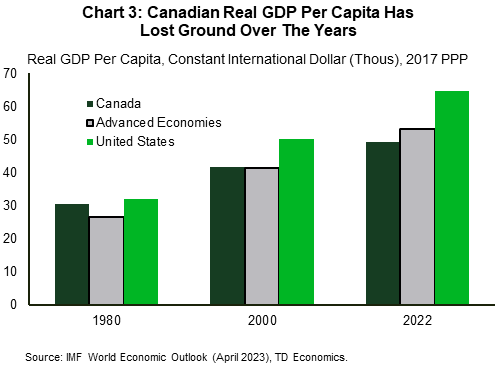
While former Prime Minister Justin Trudeau is not fully responsible for this trend, it worsened during his time in office.
There are early indications that Prime Minister Carney will be more pro-growth than his predecessor, and many Canadians will be hoping that is the case. Were Canada to fall further behind the United States and our peers, not only would our relative standard of living erode, but we would struggle to attract the kind of talent and investment that is key to long-term success. That would entrench our current underperformance.
It cannot be overemphasized how serious a problem that would be. Wealth and prosperity compound, meaning a short burst of growth and innovation can provide benefits for many decades to come. It works the other way, of course, as a decade of reduced growth (especially relative to peer nations) can create a hole that is incredibly difficult to dig out of. Just as compounding gains rapidly shift from seemingly inconsequential to overwhelming, compounding losses can seem recoverable one moment and insurmountable the next.
Thankfully, Canada has been given a tremendous opportunity to not only narrow the per capita GDP gap between ourselves and our peers but to jump ahead of the United States. This opportunity has been provided by the United States itself, or more accurately, by U.S. President Donald Trump.
Though I’ve said it before, it bears repeating: Donald Trump doesn’t understand how trade works. I don’t mean this as inflammatory criticism or a snarky aside, I mean it as a fact based upon an objective reading of his own words. The U.S. is currently led by someone who believes that you are being taken advantage of when you freely exchange money for a product or service, and that you gain money by refusing to purchase that product or service.
Trump repeated that fallacy recently, claiming the U.S. was “losing $1 trillion per year” trading with China:
Trump: “We were losing a trillion dollars a year. Now we’re not losing anything, you know? That’s the way I look at it. We were losing with China on trade a trillion dollars a year.”
Unsurprisingly, Trump’s remarks are disconnected from the facts.
To start, the U.S. imported $438.95 billion worth of goods from China in 2024, while exporting $143.55 billion, for a total trade deficit of under $300 billion, not $1.1 trillion.
Further, the U.S. has a services trade surplus of $293 billion with the world, a surplus that extends to China, though Trump never mentions this. When Apple designs iPhones in California and has them assembled in China, is America being taken advantage of? Would America benefit from shifting jobs away from the tech sector to produce clothing instead? Of course not.
Trump also ignores the fact that ‘American-made’ products often feature imports from China and other nations. Cutting off imports from China, particularly in such an abrupt fashion, leaves businesses without a chance to adjust and will lead to business closures and job losses. That won’t enrich the U.S., and it won’t create new wealth. Instead, it will destroy wealth.
U.S. imports represent the voluntary choices of American consumers and businesses. In a million individual moments, people looked at the numbers, assessed their interests and desires, and decided that purchasing a product from another country was the best decision in that moment. Nobody made them do it, they chose to do it. And letting those individual choices be made, keeping the government out of those choices to the greatest extent possible, is a key reason the United States and other capitalist democracies – including Canada – have become the most prosperous nations on Earth.
Now, the United States is turning its back on that kind of thinking, and embracing a scarcity mindset and rhetoric that is strangely reminiscent of the Soviet era in Eastern Europe, a point made by former U.S. Congressman Tom Malinowski:
A Canadian ‘Golden Age’?
The U.S. President has promised Americans a “new golden age.” However, imposing massive tariffs, sowing economic instability, and cultivating distrust among allies are hardly the way to achieve that goal, and the cost of chaos is becoming more apparent.
While announcing the decision to stand pat on interest rates, U.S. Federal Reserve Chairman Jerome Powell noted rising risks to the U.S. economy: “Uncertainty about the economic outlook has increased further,” said Powell. “The Committee is attentive to the risks to both sides of its dual mandate and judges that the risks of higher unemployment and higher inflation have risen.”
The longer the U.S. remains beholden to the economic illiteracy and instability of Donald Trump, the more opportunity will open up for Canada.
We can become a better destination for investment and talent than the United States. We can offer stability, dependability as a trade partner, immense reserves of natural resources, an immigration system that, even as we lower overall levels, respects the rule of law, human dignity, and individual freedom, and a well-educated population that has avoided a descent into unreason and anti-science sentiment. This will become increasingly attractive as the U.S. continues down its current path.
We also offer access to the U.S. market (though to what extent remains to be seen), and a business environment similar enough to that in the U.S. as to be navigable for investors pulling money from America. Investment and talent could flow into Canada at a rapid pace.
The scale of economic illiteracy from the U.S. Administration has given Canada a chance to recover from our significant economic errors over the past decade, much faster than we could have otherwise. Now, our task is to make the most of that opportunity.
Spencer Fernando
Image – YouTube
I believe in an ethical, compassionate, and beautiful future where the circle of rights continues to grow, technology is embraced, abundance is widely shared, and humanity steps further into the stars. On Patreon, I write about how we can get there.
I would be honoured to have you join the community.