Poland isn’t wasting time. They are taking the threat of war seriously, and they are preparing for it. Canada must do the same.
In my previous article, I wrote about the importance of Canada shifting to a ‘great power mindset’ by that we have the potential to be a strong country on the world stage.
One of the examples I referenced for Canada to follow was Poland, and I feel it is worth going into more detail on why Poland has much to teach our nation.
Poland’s history has turned it into one of the world’s most realistic and resilient countries. Poles know the price of vulnerability.
Their nation was invaded by both fascist Germany and the Soviet Union in 1939, and millions of Poles were killed during World War Two.
After the end of the war, Poles were ‘rewarded’ with subjugation rather than liberation.
Poland’s borders were redrawn, and the country remained occupied by the Soviets until 1991.
Following the shift to full independence and democracy, Poland unleashed an economic miracle that has turned the country from one of the poorest nations in Europe to one of the fastest-growing and innovative economies in the world.
Poland also managed to turn former foes into friends by joining NATO, deepening economic ties with Germany and other strong European economies through the European Union, and achieving a level of wealth and security that the Polish nation could once only have dreamed of.
Despite all of these positive changes, however, Poles haven’t forgotten that history always looms around the corner. They have not slipped into the naive ‘end of history’ mindset that is all too prevalent in the West.
Poland was already strengthening their military before Russia invaded Ukraine. But since Russia launched their illegal war of aggression against Ukraine, Poland has undertaken a stunning military expansion.
And who can blame them, when Kremlin-linked propagandists in Russia are saying things like this:
I think Polish farmers might want to hear this.
Russian propagandist Solovyev:
"Do the Poles want to be next? They are not Ukrainians. We will not treat them like brothers. We'll bloody destroy all those cities in an instant, without using ground troops. It's Ukraine we feel… pic.twitter.com/7LHHEdRWyA
Given the fact that Russia has kidnapped tens of thousands of Ukrainian children, deliberately slaughtered thousands of civilians, and committed horrific war crimes against Ukrainians, one can only imagine how Russia would treat the less ‘brotherly’ Polish nation.
Turning fear into strength
Poland feels a significant sense of fear towards Russia.
And that fear is justified.
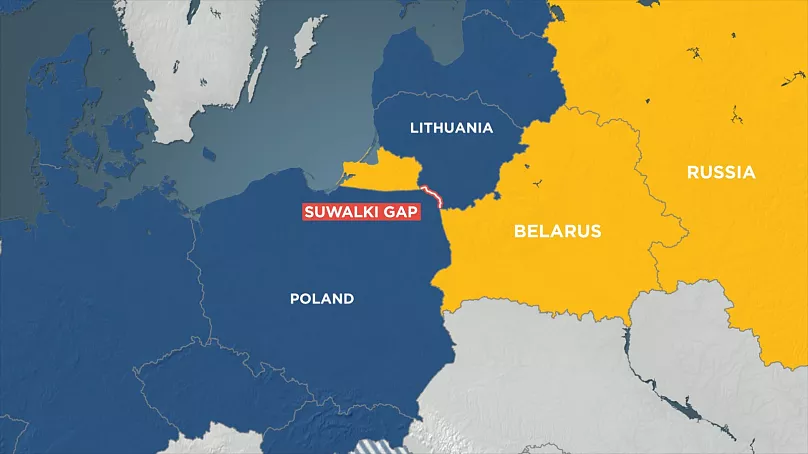
Poland effectively shares two borders with Russia, the first in Kaliningrad and the second with Belarus (a technically ‘independent’ nation – AKA Russian puppet-state – led by a Soviet-style dictator that allows Russian troops to freely travel through its territory):
Unsurprisingly, Poland has been a staunch advocate for support for Ukraine. Not only does Poland support Ukraine for moral reasons, but also because Ukraine’s survival and victory benefit Poland. Were Ukraine to be defeated, Poland would have a massive border with Russia, and Russia would be able to forcibly conscript Ukrainians to launch assaults on Poland in the event of a Russian invasion. Russia would also benefit from integrating Ukraine’s military-industrial base.
Yet, Poland isn’t going all in on betting Russia will be stopped.
Instead, Poland is doing what serious nations do:
Preparing for the worst.
And this preparation has entailed a massive expansion of the Polish military:
Poland spent 3% of GDP on their military in 2023, spent over 4% in 2024, and will hit 4.7% in 2025.
Poland’s ‘Homeland Defence Act’ intends to increase the size of the Armed Forces to 300,000 active personnel.
Poland is acquiring 250 M1A2 SEPv3 Abrams tanks from the United States, and 1,000 K2 Black Panther tanks from South Korea.
Poland has acquired 32 F-35 fighters.
Poland is acquiring 96 AH-64E Apache helicopters.
In addition to large-scale purchases that expand Poland’s military power in the short term, the country is focusing on long-term domestic production.
Poland’s deep cooperation with South Korea – another democracy that could face a brutal invasion at any moment – includes technology sharing and co-production of weapons, building industrial capacity and production knowledge within Poland:
“Poland’s military modernization is critical to NATO’s eastern defense strategy. This process involves, among other things, Warsaw’s acquisition of South Korean military hardware—including K2 Black Panther tanks, K9 Thunder howitzers, FA-50 light combat aircraft, and K239 Chunmoo multiple rocket launchers. In August, Poland acquired Husarz F-35s, with up to 32 joining its fleet, significantly enhancing its air force. These stealth fighters, paired with AGM-158 JASSM missiles (with a range of more than 1,000 kilometers and 450-kg warheads), strengthen Poland’s long-range strike capabilities. Poland has also incorporated 28 FlyEye and 24 Bayraktar TB2 drones, boosting its surveillance and combat capacity.
Warsaw’s defense modernization—underpinned by 4.3% of its GDP in defense spending with plans to reach 4.7% by 2025—reflects its determination to reduce reliance on Soviet-era equipment and to strengthen domestic defense production. A key contributor to this transformation is South Korea, one of the world’s largest military exporters. Seoul’s willingness to transfer technology and co-produce weapons in Poland—exemplified by the 2024 memorandum of understanding between Poland’s WB Group and Hanwha Aerospace—supports Warsaw’s aspiration of becoming a regional military powerhouse.”
By purchasing from both the United States and South Korea, Poland is wisely avoiding overdependence on just one supplier and is ensuring that it will be able to produce weapons domestically rather than being reliant exclusively on foreign orders – orders that could be unsustainable in a large-scale global conflict.
What should Canada learn from this?
Take a look at some of these numbers:
250 Abrams tanks.
1,000 K2 Black Panther tanks
300,000 active troops.
If someone were to propose Canada building up to a fleet of 1250 new tanks and putting 300,000 active troops in the field, it would be seen as absurd.
Yet, if Poland can do it, there’s no reason we can’t.
Poland has a population of about 38 million people, less than Canada’s population of over 40 million.
Poland’s GDP is about $800 billion USD, while Canada’s GDP is about 2.14 trillion USD.
Poland’s per capita GDP is about $22,000 USD, while Canada’s per capita GDP is about $53,000.
Canada thus has far more room to spend on our military than Poland does.
If we were to spend just 3%, our military budget would be about $65 billion USD, which would surpass Poland’s plan to spend 4.7% of GDP on their military ($40.4 billion USD).
As for building up to a force of 300,000, that would be a challenge. But not an insurmountable one. Many young Canadians are looking for work. While some of the immigrants Canada brought in during the recent immigration surge will be leaving the country, many will be staying. Many of those immigrants are young men, and if Canada is wise about providing a path to citizenship for those who serve our nation with distinction, that could be a strong incentive.
Despite our present challenges as a nation – challenges which are quite serious – we currently have the financial resources to rapidly build a military featuring thousands of tanks, thousands of self-propelled artillery guns, advanced fighter jets, modern ships, hundreds of thousands of small drones, and much more.
Poland is building such a force, and they are doing it with far fewer resources than we have.
And for those who would argue that Canada is ‘broke’ and ‘can’t afford’ a military buildup, it’s essential to remember that Poland’s budget deficit is over 5% of GDP, while Canada’s budget deficit is about 2% of GDP. Poland also has a lower credit rating than Canada (Canada remains one of the most credit-worth countries on Earth).
So again, if Poland can afford to build up its military, Canada has no excuse not to do the same.
What does Poland have that we lack?
The will to take action, and an understanding that the violence of history always looms.
Poland is acting like a serious country, while many Canadians still have their heads in the sand (though this is starting to change).
We need to emulate Poland’s seriousness. Instead of hoping for the best, we need to take action to ensure we can handle whatever the world may throw at us.