The aggressive rhetoric and trade actions of the Trump Administration have eroded decades of accumulated trust in the span of a few months.
Trust is difficult to gain and easy to lose. If someone betrays you profoundly, that betrayal will tend to crowd out and overwhelm all that came before it. This is true of people and nations.
Canada and the United States have been friends and allies for many decades. Our troops fought together, bled together, and died together in global conflicts, and many aspects of our culture have long been deeply intertwined. Canadians consume significant amounts of American entertainment, and many Canadian entertainers achieve high-level success in the United States.
Our economies have become deeply integrated, with trade between Canadian Provinces & American States often exceeding trade between those states and provinces’ national neighbours. This deal has worked out well for both nations. Canada and the United States are two of the most prosperous nations in the world (though Canada has fallen somewhat behind over the past decade), and strong cross-border trade between Canada and the United States has provided a template that other regions are often eager to emulate.
These deep economic ties also created a deep sense of residual trust between Canada and the U.S. Even when American Presidents were unpopular in Canada (George W. Bush, for example), Canadians and Americans still largely saw each other as family.
That is no longer the case.
And while profound shifts and ruptures in national relationships often have complex causes, this rupture has been caused by one individual:
U.S. President Donald Trump.
That may seem overly simplistic to some, but ask yourself the following question. Would Ron DeSantis have launched a tariff war against Canada? Would Nikki Haley threaten to annex Canada and turn us into a U.S. State? Would Doug Burgum be talking about any of this? How about Kamala Harris?
We know the answer.
Had any of the other credible contenders for the U.S. Presidency in 2024 won the 2024 election, Canada would not be in this situation. But alas, those credible contenders did not win. Donald Trump did, and here we are.
And after a few months of Donald Trump’s near-relentless on-again, off-again trade threats and talk of annexation, the relationship between Canada and the United States has been irreparably changed. When our sovereignty is not respected and when previously signed trade deals are treated as worthless, it is impossible to build a solid foundation of trust.
Now, it may seem odd to be saying this today, given the call between Prime Minister Mark Carney and President Donald Trump seemed to go well, according to post-call statements issued by both leaders:
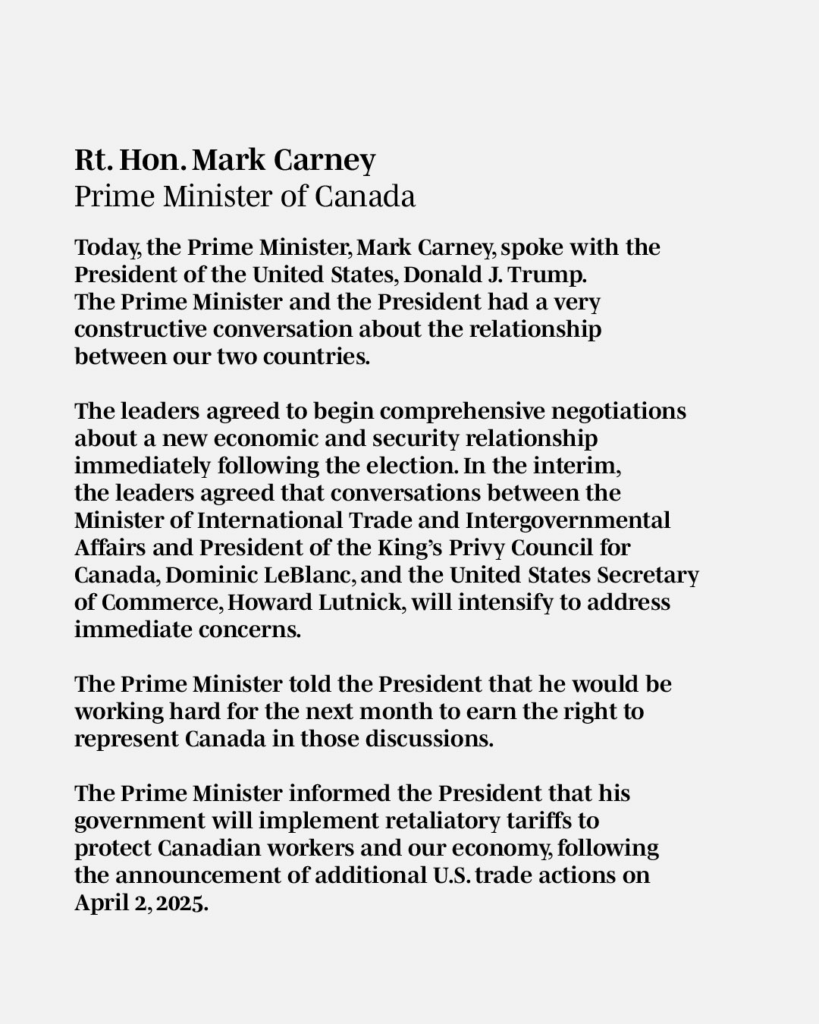
“I just finished speaking with Prime Minister Mark Carney, of Canada. It was an extremely productive call, we agree on many things, and will be meeting immediately after Canada’s upcoming Election to work on elements of Politics, Business, and all other factors, that will end up being great for both the United States of America and Canada. Thank you for your attention to this matter!”
The fact that this is being treated as a positive statement only goes to show how much the relationship has deteriorated. After all, tariffs on Canada are still likely to be imposed on April 2nd. And speaking today in Greenland (a territory of Denmark the United States is ominously musing about ‘needing to have’, U.S. Vice President JD Vance repurposed Donald Trump’s “don’t have the card” line against Canada:
It’s easy to lose sight of how bad the relationship has gotten, but going a few days without our sovereignty being questioned by the United States is no cause for celebration. And it could all change tomorrow. We’re always one Trump ‘Truth Social’ post away from another cycle of annexation fever.
In this environment, Canada must assume the worst regarding economic ties with the United States, while still hoping for the best. And assuming the worst means doing everything in our power to reduce our reliance on the United States as quickly as possible. We have to keep our elbows up and avoid letting down our guard. Were we to slip back into complacency, we would fail to take the actions now that are necessary.
It is important for us not to lose sight of the fact that the potential damage we are facing from tariffs is only happening because the United States is unilaterally violating trade deals they agreed to. Canadians are paying the price for U.S. dishonesty:
And so, with the need to keep our elbows up in mind, here are five steps we can take to navigate this difficult moment and build long-term economic strength and resilience to reduce our reliance on the U.S.
1 – Embrace deeper economic cooperation with the European Union, Japan, and South Korea
While Canada’s economy is under assault from the United States, we are not alone in this. The Trump Administration is launching trade actions against nearly every nation in the world. Understandably, these nations feel a sense of solidarity with Canada at this time, and we should make the most of it. Rather than retreat into a Canadian form of isolationism, Canada should deepen its cooperation with other nations, particularly European Union members and like-minded countries in Asia such as Japan and South Korea. We should send a message that we are open for trade and open for business. And, given that Canada is energy-rich compared to much of Europe and Asia, we have much to offer them – something they are no doubt aware of.
2 – Push for CANZUK
I will address CANZUK in more detail in a coming post, but suffice it to say that a free trade and free movement zone with Australia, New Zealand, and the United Kingdom would be of huge benefit for Canada, for three reasons:
- CANZUK helps strengthen our connection to Canada’s British history and unique identity at a time when that identity is essential to holding the line against those pushing for Canada to be annexed by the United States.
- Canada’s sovereignty will be better protected if the United Kingdom, Australia, and the U.K. feel a deeper sense of connection to our nation.
- The combined economic strength of the CANZUK nations (GDP of nearly 10 trillion CAD) would ensure Canada is part of a formidable economic zone and would give our companies, entrepreneurs, and workers more leverage.
And – as with point 1 – CANZUK would send a signal that Canada is serious about mutually beneficial cooperation with others at a time when the United States is going in the opposite direction.
3 – Erase interprovincial trade barriers
Interprovincial trade barriers are not always what they seem. Sometimes they are simply different ways of doing things that have emerged organically in different provinces. Still, to the greatest extent possible, those barriers need to be brought down. This is a conversation that has picked up considerable steam due to the urgency of the economic threat from the United States, and it is essential that the momentum not be lost. Parochial interests cannot be allowed to take precedence over Canada’s economic future. For example, all provinces should get on board with pipelines to ensure that Canadian oil & gas reach every part of our country and reach willing foreign buyers.
4 – Welcome top talent from the United States
With a growing sense of a clampdown on government criticism and open inquiry, many scientific experts, professors, and other talented individuals are considering leaving the United States. It would be wise for Canada to welcome those individuals with open arms. This would be a great way of countering America’s tariffs against Canada. If we can draw in some of America’s most well-educated and intelligent people, Canada’s economy, reputation, and long-term potential will benefit.
Canada’s burgeoning tech sector – the sector that will largely define who leads the global economy in the 21st Century and beyond – could be a big beneficiary of fleeing U.S. talent.
As reported by RestofWorld, tech professionals are looking to head for the exits:
“Tech professionals around the world are on the edge as President Donald Trump and his administration impose a series of radical immigration measures.
From attempting to deport foreign nationals who are permanent legal residents to barring visitors from entering the country for expressing views on U.S. foreign policy, immigrants have seen a tumultuous couple of months.
Last week, reports said the U.S. government is considering placing travel restrictions on citizens from 43 countries. The plan would completely ban travel from 11 nations, impose heavy curbs on 10 others, and give 22 countries a 60-day ultimatum to address perceived deficiencies or risk moving to one of the other categories.
While workers from the targeted nations make up a relatively small percentage of the tech workforce, industry professionals outside the purview of the measures, too, have been increasingly concerned about being impacted by the shifting visa policies and anti-immigration rhetoric.
They are particularly worried about increased scrutiny of the H-1B visa, which is sought after by tech companies.
Immigration attorneys are now advising clients on temporary U.S. visas to avoid leaving the country, warning they may encounter difficulties when attempting to return.”
While Canada should bring down immigration levels overall for the time being – something both the Liberals and Conservatives appear inclined to do – we could still benefit from shifting the balance in a way that will bring in more talent. America’s loss would be Canada’s gain.
5 – Build up Canada’s military industry
Yes, I know I mention this often. And I’m going to keep mentioning it. The most important job of the federal government is to ensure a strong national defence, and that can’t be accomplished solely through purchasing equipment made abroad, though that can help. In the case of a large-scale war it would be challenging to rely upon nations that would themselves likely be embroiled in conflict. That’s why it is important to have a strong, homegrown military industry. And this can be a significant source of economic activity and national research & development.
Many nations, including South Korea, Israel, Poland, and increasingly Germany and France, utilize defence spending as a key economic driver. The kind of investment necessary for building a strong military industry also leads to countless spinoff jobs and the development of the kind of expertise that strengthens the broader economy. A homegrown Canadian military buildup would require investment in the aviation industry, armour industry, small arms manufacturing, university research & development, expanding the drone industry, artificial intelligence, and much more.
As Canadians, we must keep our guard up and keep our elbows up as we face this threat to our economy. We can be – and should be – one of the wealthiest nations on the planet, even in the face of U.S. instability, dishonesty, and relentless pressure.
Spencer Fernando
On Patreon, I create more content for a strong and sovereign Canada.
Prefer a one-time contribution? You can give via PayPal.