The U.S. President’s zero-sum view of global commerce betrays a deep misunderstanding of modern economics.
The U.S. President is economically illiterate.
It gives me no pleasure to write that, given the implications. But it is undeniable at this point. The leader of the world’s largest economy truly believes that mutually beneficial trade doesn’t exist, and that any trade, whether between individuals or nations, must involve one party taking advantage of the other. He believes there must be a winner and a loser in every transaction. He believes having a ‘trade deficit’ with another country means that country is somehow tricking the United States, even though the balance of trade represents American companies and consumers willingly entering into trade relationships with others.
But no matter how strongly Donald Trump believes a myriad of falsehoods on the issue of trade, he’s wrong.
The overwhelming majority of transactions in the global economy are voluntary. People tend not to voluntarily disadvantage themselves. Thus, most trade is mutually beneficial, at least from the perspective of those engaging in the trade. You can intuit this when you consider your own life. Are you taking advantage of your hairstylist when you give them money and receive a haircut in return? Are they taking advantage of you? Of course not.
You have a trade deficit with your local restaurant. You don’t sell them goods or services in exchange for food and service, you give them money. Are they taking advantage of you? Again, the answer is no.
This is where we can see that Donald Trump’s view of trade is entirely dependent upon ignoring the complexities of even local economies, let alone national and global ones. You may have a trade deficit with your hairdresser or local restaurant, you, or the company you work for – has a trade surplus with someone else, who in turn has deficits and surpluses with others. All of those transactions were voluntary, and those who engaged in the transactions are, on the whole, better off for having made them.
Sure, you could technically learn how to cut your hair and learn how to make restaurant-quality food, but mastering those skills would deprive you of other opportunities and take up precious time. If everyone tried to be good at everything, we would all be far less efficient and far worse off.
Unfortunately, Donald Trump’s economic illiteracy is now the foundation of U.S. trade policy. It is thus unsurprising that the much-hyped “liberation day” tariffs announced by the U.S. President were poorly thought out and appear to have been based upon an absurd formula for calculating the tariff rate of other nations.
Here’s how James Surowiecki described it in a series of Twitter posts:
“Just figured out where these fake tariff rates come from. They didn’t actually calculate tariff rates + non-tariff barriers, as they say they did. Instead, for every country, they just took our trade deficit with that country and divided it by the country’s exports to us.
So we have a $17.9 billion trade deficit with Indonesia. Its exports to us are $28 billion. $17.9/$28 = 64%, which Trump claims is the tariff rate Indonesia charges us. What extraordinary nonsense this is.”
“It’s also important to understand that the tariff rates that foreign countries are supposedly charging us are just made-up numbers. South Korea, with which we have a trade agreement, is not charging a 50% tariff on U.S. exports. Nor is the EU charging a 39% tariff.”
This has resulted in some nations with high tariffs on the U.S. being treated as if their tariffs are low because the trade deficit is low, and vice versa. The U.S. even has free trade agreements in place with some of the countries they slapped with tariffs.
In some cases, countries are being hit with the across-the-board 10% ‘reciprocal’ tariff even though the United States has a trade surplus with that country. That’s the situation Australia finds itself in, as they are going to be tariffed despite buying more from the United States than it sells to the United States.
Let’s also not forget that not only is Donald Trump’s overall view of trade wrong, but he also doesn’t understand how tariffs work. Trump repeatedly claims – as do many of his more sycophantic officials – that tariffs are “paid for by the country being tariffed.” But that’s not how it works. When Canadian aluminum gets tariffed by the U.S., Canada pays nothing. Instead, any U.S. company that buys Canadian aluminum gets hit with the tariff in the form of a tax on the aluminum they wish to purchase. This is meant to disincentivize imports and incentivize domestic production, but it only ‘works’ by deliberately driving up prices. Thus, tariffs are a tax paid for by the Citizens of the country imposing the tariffs. This is something Donald Trump’s Republican defenders once understood, but now choose to ignore as they defend the indefensible.
One or the other
Further evidence of Trump’s economic illiteracy is how his administration simultaneously promotes tariffs as a revenue-generation tool and as a way to build up domestic manufacturing. Trump has mused about replacing the income tax with tariff revenue, and one of his advisors, Peter Navarro, has claimed tariffs could bring in $600 billion per year.
But that’s not how it works. If tariffs bring in significant revenue year after year, it means people are eating the cost of the tariff rather than buying domestic products. Steady tariff revenue requires steady import volumes. Meanwhile, if tariffs push people to buy domestically, it means they are purchasing fewer imported products. Fewer imports mean smaller tariff revenue. It should also be noted that the White House explicitly says their goal is the reduction of imports, which would lead to dwindling tariff revenue:
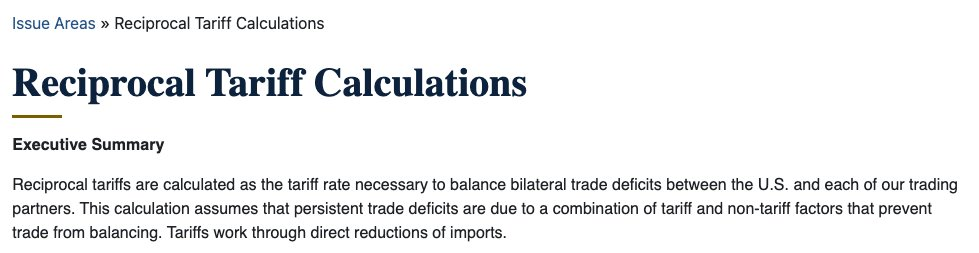
If the White House achieves its stated goal of reduced imports, how will it achieve its goal of bringing in vast new revenue from tariffs?
What about Canada?
Today was not as bad as it could have been for Canada. Canada and Mexico are among the few countries that did not have new tariffs imposed, and the White House has indicated that CUSMA-compliant products are exempt from tariffs:
“For Canada and Mexico, the existing fentanyl/migration IEEPA orders remain in effect, and are unaffected by this order. This means USMCA compliant goods will continue to see a 0% tariff, non-USMCA compliant goods will see a 25% tariff, and non-USMCA compliant energy and potash will see a 10% tariff. In the event the existing fentanyl/migration IEEPA orders are terminated, USMCA compliant goods would continue to receive preferential treatment, while non-USMCA compliant goods would be subject to a 12% reciprocal tariff.”
However, the fact that we are ‘celebrating’ not being hit with a blanket tariff shows how significantly the relationship between Canada and the United States has eroded. The Canadian auto sector will still face tariffs. The steel and aluminum sectors are facing tariffs. And as noted by former Alberta Premier Jason Kenney, larger tariffs could still be imposed at any moment:
Today’s US tariff announcement is nothing to celebrate.
Entire Canadian industries still look to be clobbered by arbitrary US tariffs.
And the sword of Damocles continues to hang over us: the on-again-off-again “emergency” 25% tariff on Canadian exports imposed two months ago is re-affirmed in today’s executive order, but is suspended indefinitely.
In other words, Presidential whim and fiat will continue to govern our most important trade relationship.
Wednesday evening, Stellantis announced it would be shutting down its Windsor plant for two weeks due to the tariffs being imposed by Donald Trump. Canadian workers are already paying a price for Trump’s reckless trade actions. As a result of these ongoing tariff threats and threats to our sovereignty, our ability to trust the United States has been fully eroded. And this erosion of trust gets at one of the long-term consequences of Trump’s tariff policy.
A more dangerous world
America’s word cannot be trusted. America can not be relied upon. Signing a trade deal with Donald Trump means nothing if he decides it means nothing. After all, Canada has deals in place that should prevent tariffs on made-in-Canada vehicles, but those vehicles may be tariffed nevertheless. Many countries facing significant tariffs, including nations like Japan, South Korea, and India, have signed trade deals with the United States in the past. The U.S. is thus ‘rebelling’ against a world trade order it largely established.
The danger here is that countries will – understandably – feel there are fewer benefits from allying with the United States, and will hedge their bets by getting closer to China. Right now, all China has to do is sit back and watch as the United States alienates countries around the world, before potentially swooping in with favourable trade deals. America appears unstable and untrustworthy, and far less committed to working with its allies.
Evan A. Eigenbaum summed it up nicely on Twitter:
“The U.S. is pretty much done strategically in Southeast Asia. The region is filled with pragmatists, who can and do navigate all kinds of crazy stuff from outside powers. But that depends greatly on those players being either principled or strategic—and Washington is now neither.”
A global trade conflict will also push many countries into a more desperate economic situation, which tends to increase support for extremists on the far left and far right, which then increases global instability.
That is less than ideal.
Let’s not mince words: This was a bad day for the world. Because of the economic illiteracy of one man – and the politicians who support him despite knowing better – the global trading order that helped to promote unprecedented peace and prosperity for decades is being ravaged rather than reformed.
These moments of ‘beggar-thy-neighbour’ trade policy often presage large-scale wars. While we must hope that isn’t the case this time, we will need to prepare for this eventuality.
Still, our nation has agency and we have options. That’s why, in an upcoming post, we’ll look at how Canada can take advantage of America’s inward turn and deepen our connections with other nations that still value trade and mutually-beneficial cooperation.
Spencer Fernando
If you found this useful, you’ll want the full picture.
Subscribers receive exclusive analysis on Canada’s foreign policy, national defence, and geopolitical trajectory.
$6/month or $72/year.
On Patreon, I create more content for a strong and sovereign Canada.
Prefer a one-time contribution? You can give via PayPal.