Canada must rearm quickly, and Ukraine’s battlefield-tested drones offer exactly the capabilities we need.
There are many reasons to support Ukraine in its fight against Russia’s invasion.
Much of that support is grounded in moral and ethical principles. Ukraine is the victim of unprovoked aggression. Ukraine is a sovereign nation that has the right to chart its course and choose its alliances. Ukraine is a pro-Western democracy that is making good faith attempts to address corruption and integrate itself into credible alliances like the European Union and NATO.
By contrast, Russian dictator Vladimir Putin is the aggressor. Russia launched the largest invasion in Europe since the Second World War. Russia believes it has the right to dictate Ukraine’s alliances, form of government, and future. Russia has kidnapped thousands of Ukrainian children, has slaughtered tens of thousands of Ukrainian civilians, and killed many tens of thousands of Ukrainian soldiers who were simply defending their home. Multiple independent investigations have found that Russian forces have committed widespread war crimes and crimes against humanity in the occupied regions of Ukraine:
“A United Nations investigation has found further evidence that Russian forces committed “indiscriminate attacks” and war crimes in Ukraine, including rape and the deportation of children to Russia.
“The collected evidence further shows that Russian authorities have committed the war crimes of wilful killing, torture, rape and other sexual violence, and the deportation of children to the Russian Federation,” a United Nations commission of inquiry on Ukraine said in a report submitted to the UN general assembly.
“The commission has recently documented attacks that affected civilian objects, such as residential buildings, a railway station, shops, and a warehouse for civilian use, leading to numerous casualties.”
Russia has repeatedly denied targeting civilians and has said Ukrainian allegations of war crimes are concocted.
The commission said it had focused its recent investigations on Kherson and Zaporizhzhia provinces and found “evidence that Russian authorities committed rapes and sexual violence in a district of Kherson province”.
Thus, Russia’s invasion of Ukraine is a moral test. Have we learned anything since the Second World War? Have we learned to halt the advance of expansionist dictators before it’s too late? Have we learned to support nations, like Ukraine, fighting for their survival against a ruthless aggressor?
These questions are of deep moral import, and to many people – including myself – provide sufficient justification for providing significant military aid to Ukraine. Even if Canada did not benefit from aiding Ukraine, I believe it would be the right thing to do.
That said, when Canadians are asked to give a portion of their tax dollars to support a cause, it is understandable that people want to hear what benefits supporting that cause will bring to our country. Many benefits of aiding Ukraine have been discussed in detail for some time. We benefit from bolstering our reputation among the European allies we would expect to support our sovereignty. We benefit from being seen as a nation that keeps its word (we promised to aid Ukraine early on and are adhering to that promise). And we benefit from helping keep Russia in check in Ukraine, reducing the likelihood of a Russian invasion of the Baltic nations or a large-scale incursion in the North, both of which could draw in direct Canadian participation.
Those are all solid, tangible reasons for aiding Ukraine. There is, however, another reason that has garnered less attention, but that could bring about the largest benefit for Canada:
Access to advanced military technology.
The Canadian Armed Forces are currently too small and too ill-equipped to meet our current security needs, let alone the needs of a rapidly destabilizing world. Were Canada to be plunged into a large-scale war today, we would find ourselves short of ammunition, short of tanks, short of advanced combat aircraft, short of missiles, short of anti-tank weapons, short of anti-drone weapons, short of drones, short of ships, short of submarines, and short of troops. Decades of underinvestment in the Armed Forces have a cost.
This situation would be far worse were it not for the bravery of the Ukrainian People. By fighting back so vociferously against Russia, Ukraine has bought the world time to rearm, and they have weakened the most likely foe of Canada and our European allies – Russia. But with Russia having converted to a full war economy, and with their investment in an Arctic military buildup continuing apace despite immense losses in Ukraine, time is running out for nations like Canada.
With this in mind, we cannot assume that rebuilding our military can be done at a leisurely pace. We must act as quickly as possible. As a corollary, we must invest in capabilities that can be scaled up fast. We don’t have 10 years to wait for equipment to be delivered.
And this is where Ukraine comes in.
If Canada supports Ukraine now, both in principle and in practice, we may gain privileged access to military technologies Ukraine is offering only to members of the ‘guarantee force,’ a coalition of countries prepared to help enforce any future ceasefire.
Why Ukraine’s Drone Revolution Matters for Canada
Ukraine has made significant advances in drone warfare, advances which have helped Ukraine to offset Russia’s numerical advantage in the skies, seas, and in terms of manpower. Ukraine’s situation is relevant for Canada, given that were we to be embroiled in a large-scale conflict, we would be outgunned by any adversary in raw terms. For example, there is little prospect of Canada being able to match Russia or China’s naval strength in the Arctic (especially if we have to fight without U.S. assistance). And though we are scaling up our production of icebreakers and are undertaking the purchase of new submarines, those assets will not be available in significant numbers in the short-term. Further, our air force is many years away from acquiring meaningful numbers of advanced combat aircraft, and our recruiting challenges mean that we must be able to buttress limited troop numbers with drone capabilities that are scalable, affordable, and technologically advanced.
Ukraine offers battlefield-proven technology that Canada can adopt and integrate now, not years from now. Let’s look at those technologies in more detail:
Naval drones
Despite not possessing a navy, Ukraine was able to push most of the Russian Black Sea fleet out of Crimea, and sank/damaged about a third of the fleet:
“After Ukraine reportedly lost all of its remaining surface vessels in the early months of the full-scale war, Russia was widely expected to have a free hand in the Black Sea.
But innovative tools such as Magura and Sea Baby naval drones and domestically made Neptune missiles turned the tide.
Ukraine celebrated its most successful “kill” when the missile cruiser Moskva, the Black Sea Fleet’s flagship, sunk on April 14, 2022, after being struck by two Neptune missiles — marking Russia’s first flagship loss since the Russo-Japanese War in 1905.
Ukraine built on its successes, retaking key positions like the Snake Island off the coast of Odesa and, striking Russian naval facilities and docked vessels in Crimea with Western SCALP and Storm Shadow missiles.”
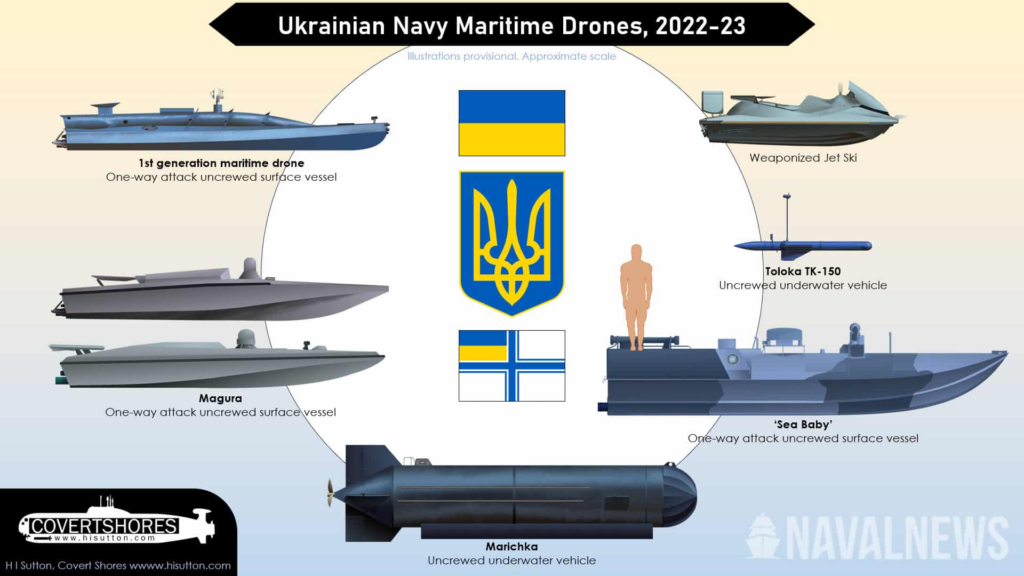
These naval drones range in cost, with estimates putting the cost of one type of naval drone at $250,000. If a multimillion-dollar ship can be destroyed or taken out of commission by a $250,000 drone, that is a good tradeoff, and it is the kind of tradeoff Canada will need to be capable of if we are to effectively defend the North within the next few years.
Aerial Drones
Ukraine’s use of aerial drones has been nothing short of revolutionary. Borne of necessity – both the necessity of finding an alternative to often-scarce artillery shells and the necessity of reducing casualties in the face of Russian ‘meat assaults’ – Ukraine has become the world leader in the use of aerial drones.
As noted by the Centre for Strategic & International Studies, Ukraine has the goal of replacing humans on the battlefield with autonomous systems:
“When it comes to technology, the Ukrainian military identifies removing warfighters from direct combat as its central objective in shaping the future battlefield. This goal is not simply an ambition; instead, it is an existential necessity for the Ukrainian armed forces. Given the substantial numerical superiority of Russian forces, Ukraine faces significant constraints on human capital, training resources, and time spent preparing warfighters.
Furthermore, human personnel face inherent vulnerabilities, including fatigue, susceptibility to adverse weather conditions, and psychological stress. These human factors substantially impact operational sustainability and combat effectiveness, thereby reinforcing the tactical and strategic imperative for increased battlefield autonomy.”
An essential factor in Ukraine’s successful deployment of aerial drones has been its ability to mass produce drones domestically at scale:
“In 2024, Ukrainian defense companies manufactured and assembled more than 1.5 million FPV drones. They also produced other advanced platforms, including strike quadcopter bombers, kamikaze drones, winged reconnaissance drones, and long-range deep-strike drones. Overall, Ukraine produced approximately 2 million drones in 2024. Notably, 96.2 percent of all UAVs that the Ukrainian armed forces used in 2024 were produced domestically, demonstrating the country’s increasing reliance on homegrown technology and localization of production components.
Ukraine has also introduced into its arsenal more than 200 domestically developed unmanned aerial systems and more than 40 ground robotic platforms since February 2022. Most of these new systems entered service in 2024, showing that local manufacturing is adapting to war conditions and establishing reliable supply chains. Specifically, 140 UAV complexes (designs and unique configurations) and 33 ground robotic systems were approved for operation in the first nine months of 2024 alone. Together, these developments indicate a strategic move to increase self-sufficiency, reduce supply chain risks, and ensure that the Ukrainian military can rapidly adapt to the evolving demands of modern warfare.”
Ukraine is thus increasingly able to defend itself without needing to rely upon external sources (though many items such as foreign-produced fighter jets, tanks, armoured vehicles, and – above all – artillery shells – remain essential).
It should be emphasized that Canada, with a well-established tech sector, advanced manufacturing capabilities, a well-educated population, relatively high per capita GDP, and a strong aerospace sector, is incredibly well-positioned to emulate Ukraine’s mass production of drones. And if we were to work closely with Ukraine, we would be able to skip over the entire initial development phase and start mass producing – and then iterating upon – Ukrainian drones. Any potential adversary, particularly Russia or China, would think twice about making an incursion on Canadian territory if they feared being drowned in a swarm of advanced Canadian-made drones.
Rapid iteration could also turn Canada into an exporter of drones and could help us expand our air power even absent purchases of new fighter jets. Our aerospace companies could start developing long-range stealth drones that would give us tactical/strategic bombing capability, and we could even develop fighter drones that, while less effective than advanced fifth/sixth generation fighters, would provide us with aerial combat capability for a relatively low per-unit cost.
Land drones
While the use of ground drones has not matched the scale of aerial and naval drones, Ukraine continues to make advances in ground warfare:
Mykhailo Fedorov, Ukraine’s Minister for Digital Transformation, reported at the end of November how around 100 Ukrainian-manufactured unmanned ground systems (UGS) drones had been exhaustively tested for use in combat at the Brave1 testing ground. The drones were designed to fulfill a wide range of combat and support functions including medical evacuation, logistics resupply, remote assault missions, minelaying, and kamikaze attack vehicles.
The majority of these were first-person view (FPV) guided vehicles that relied on good communications to fulfill their missions. As with their air and seaborne counterparts, the emergence of Russian battlefield electronic warfare (EW) has proven to become an obstacle to their utility. However, advances in artificial intelligence (AI) are swinging the pendulum back toward improving their effectiveness.
In late 2024, Ukraine conducted what is believed to be the first all-drone, multi-domain assault:
“Ukraine successfully pulled off an all-drone, multi-domain attack on Russian positions near Kharkiv in December, an official speaking at the International Armoured Vehicle (IAV) conference disclosed this week, in what they are calling the first-ever such operation.
Addressing delegates under the Chatham House Rule at Defence iQ’s IAV event here, the official described how the operation exclusively featured weaponized uncrewed ground vehicles (UGVs) and first person view (FPV) attack drones and did not feature any crewed platforms or boots on the ground.”
With ground drone warfare certain to become more common, and given Canada’s recruitment challenges, being able to buttress our ground forces with unmanned ground platforms will be essential to improving our combat capability going forward.
Mutual benefit
Ukraine is more than willing to share its technology and help others learn the lessons of war – lessons Ukraine has learned at great cost. However, Ukraine rightfully plans to share those lessons only with those who are planning to take an active role in ensuring Ukraine’s survival.
Ukrainian President Volodymyr Zelenskyy has made clear that if countries want access to Ukrainian technology, of which drones would be the most sought-after, they must be part of the ‘guarantee forces’ committed to helping enforce a ceasefire whenever one is reached:
“Our technologies, the developments we’ve made during this war, such as those related to drones, missiles, and air defense – we will share these developments with the partner countries that guarantee our security with their contingents,” Zelenskyi noted.
The so-called Coalition of the Decisive, led by France and the United Kingdom, has been working for several weeks on a plan to send thousands of troops to Ukraine to ensure a future “ceasefire.”
This is an eminently reasonable request. Ukraine’s advances in drone warfare have come at a tremendous cost. Canada – and our allies – have benefited from Ukraine’s weakening of Russia, while Ukraine has taken all of the casualties. It is only right that if Canada wishes to benefit from Ukrainian technology that we participate in protecting a ceasefire. This would mean Canadian troops working alongside British & French troops – and troops from other allied nations in Ukraine once a ceasefire is reached.
The Strategic Case for Joining the Guarantee Force
It is important to be clear on this point, as some have attempted to twist it for propaganda purposes. Canada and our allies would not be engaging in combat operations against Russia, and we would not be ‘entering the war.’ Such a deployment of troops would only occur when fighting has ceased, and the deployment would be meant to dissuade future Russian aggression. It would be similar to deployments of U.S. troops in South Korea. Those troops are not fighting against North Korea, rather, they are making it clear to North Korea that an incursion into the South would bring multiple nations to South Korea’s defence. It would resemble peacekeeping missions or tripwire deterrents, not active combat deployments. Its purpose would be to reinforce a ceasefire agreement, not to conduct military operations.
Such a deployment would bring about a mutually beneficial situation. Ukraine’s security would be enhanced, while Canada’s rearmament would get a significant boost from access to Ukrainian drone technology.
What Canada Must Do Next
As the world becomes more fractured and unstable, Canada must take action to bring about outcomes that are consistent both with our values and with our national interest. Assisting in the preservation of long-term peace in Ukraine in exchange for access to military technology that can bolster our security is a perfect example of just such an action. Canada should publicly commit to joining the guarantee force, begin talks on joint drone development with Ukraine, and set aside procurement funds to ensure development and production of new drones can begin as rapidly as possible. Such a decisive move could rapidly shift Canada from a position of military weakness to a position of growing military strength.
Spencer Fernando
Photo – YouTube
On Patreon, I create more content for a strong and sovereign Canada.
Prefer a one-time contribution? You can give via PayPal.