Instability in the U.S. is creating space for responsible powers to rise.
The United States of America under Trump 2.0 is still in the ‘temporary stimulus surge’ phase of its influence. Because of the immensity of the U.S. economy and how much of the global trading and finance system is built around the U.S., the world is forced to deal with the Trump Administration, no matter how much we may not want to.
This means the U.S. can rapidly do significant damage to other economies, corporations, and consumers around the world. This ability to inflict damage exists as a consequence of America’s raw power. However, this raw power has long been complemented by America’s reputational strength (AKA ‘soft power’). The spread of American culture, American rhetoric, and American political ideology, alongside a sense that America would ultimately stand for what is right and stand by its allies, gave America a level of global influence that was unmatched in history.
Since we have lived in a U.S.-dominated world for such a long time, it’s easy to forget how unprecedented it is for countries across the globe to have asked for U.S. military bases to be put on their territory, and how significant it is that many willingly sought to integrate themselves into a global trading order that was built by the U.S., rather than having to be coerced into that order.
This order will not disintegrate overnight (not even with the U.S. President seeking to bring about its disintegration), nor will countries be able to find alternative partners or deepen existing trading partnerships overnight. Thus, the United States will still find world leaders running to the White House & Mar-a-Lago to try and sign deals to stave off devastating on-again-off-again tariff threats and mitigate the damage to their national economies.
However, just as reckless economic stimulus represents an artificial boost of growth that ultimately turns into a long-term slowdown, the United States will ultimately pay a price for its current instability. Even the countries rushing to make deals with the Trump Administration are undoubtedly resentful at being put in such a difficult situation.
For example, Australia and Vietnam are unlikely to overlook the indiscriminate application of tariffs, especially when such measures contradict fundamental trade principles.
Canadians are unlikely to forget that our sovereignty has been threatened, nor are we likely to forget that the U.S. imposed tariffs on us despite our nation abiding by the CUSMA trade deal that was signed, and at one time praised, by none other than Donald Trump
This will be remembered and acted upon. Evidence of this is already emerging.
As noted by American stockbroker Peter Schiff, “America’s ride on the global gravy train” is ending:
“I’ve never seen such a mass selloff of U.S. assets. The U.S. dollar, bonds, and stocks are all getting killed. I can’t remember when the dollar lost 3.5% against the Swiss franc in one day. America’s ride on the global gravy train is about to come to a screeching halt. Buckle up.”
Schiff also believes the U.S. Dollar is on the way down:
“So far Switzerland, Japan, and the EU are winning Trump’s trade war. Their currencies are surging against the U.S. dollar. That means that our goods are getting much cheaper for them while their goods are getting more expensive for us. Add in tariffs and Liberation is expensive.”
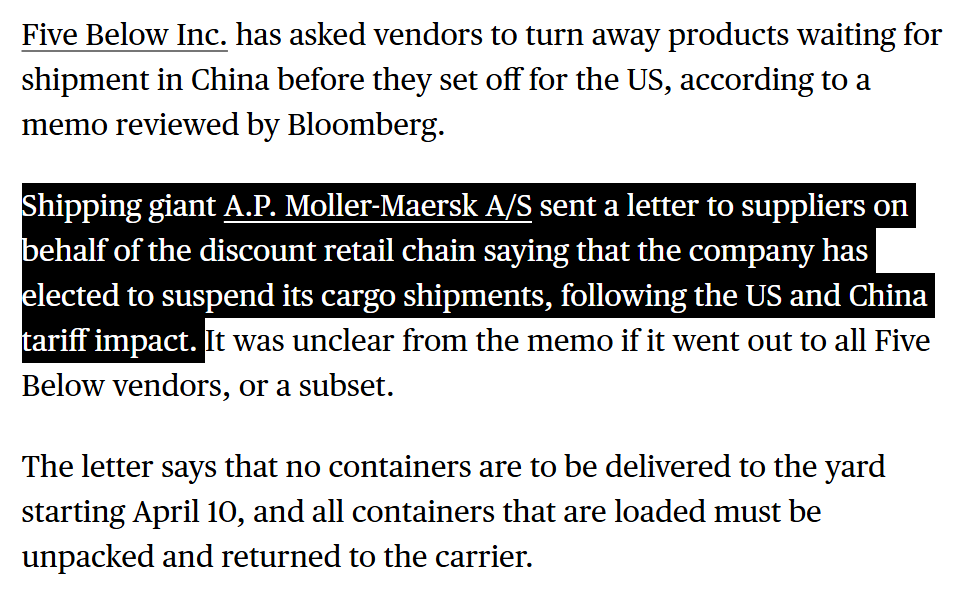
Bloomberg noted that trade is already starting to freeze as U.S. tariffs on China take effect:
These market disruptions are not isolated events; they reflect a deeper realignment of international economic trust.
Canada’s opportunity, and the mindset shift we need to seize it
In this emerging paradigm, Canada has a rare opportunity to reposition itself, not merely as a participant in the U.S.-dominated framework, but as a principled advocate of open markets and institutional reliability.
Despite the recent walkback of the absurdly calculated tariffs announced on so-called ‘liberation day,’ Donald Trump has wiped out a century of U.S. trade liberalization. America – once the world’s staunchest defender of free trade (which helped the U.S. become the wealthiest and most powerful nation on Earth) – is now one of the most protectionist nations on Earth.
In a note, Bloomberg Economics economists Rana Sajedi, Maeva Cousin and Tom Orlik pointed out that the average U.S. tariff rate is now 24%, compared to 22% when Trump took office for the second time, and they expect the shock to “play out over two to three years.” They also add this salient point:
“Trump appears to consider uncertainty a positive for negotiations. For businesses and markets, it’s a drag.”
Just as erratic economic leadership encourages people to seek safe havens, investors, corporations, and companies will be looking for alternatives to an unstable U.S.
Canada can – and must – capitalize on this. And to do so, we need a significant mindset shift. We must lead, not follow.
America is turning against the idea of competition. Free market thinking in the United States is under assault from both the left and the right, and the nation is turning inward. In this environment, Canada should move in the opposite direction, and become a haven of not only social freedom, but economic freedom as well.
Rather than stifling competition as we have done all too often, Canada should embrace it, positioning ourselves as the best place in the world to do business. We can do this while building on our perceived strengths. Canada is seen as a stable country, a country where the rule of law is robust, and where people of all backgrounds are welcomed. If we can merge that positive reputation with a perception that we are a top-tier place to invest, work, and live, we can become a magnet for capital and thus benefit from the errors made by the Trump Administration.
As the world prices in U.S. instability, equilibrium will be sought elsewhere
We are witnessing the recalibration of the post-Second World War global order. We can no longer trust or assume that America’s commitment to open markets and institutional stability will remain constant.
This instability introduces systemic risk, disrupting commerce, supply chains, and capital flows, and this risk cannot be mitigated by short-term dealmaking or rhetorical assurances. The erosion of trust in America is accelerating, and this erosion is shaping new economic alignments. Going forward, credibility, not coercion, will become the ‘premium asset’ for nations seeking to prosper.
In this environment, it is essential not only to project strength but also consistency to give market participants a sense of long-term stability and predictability. While the U.S. will retain raw leverage for a while, as with all imbalances of power unmoored from legitimacy, a correction is inevitable
Markets, like politics, seek equilibrium. As the world recalibrates in response to U.S. unpredictability, that equilibrium will increasingly be sought elsewhere, and Canada, if it embraces consistency and openness, is well-positioned to lead.
Spencer Fernando
On Patreon, I create more content for a strong and sovereign Canada.