Stability is becoming the world’s most valuable asset. Canada has a rare opportunity to brand itself as the dependable alternative to U.S. volatility.
The Dow Jones Industrial Average fell over 950 points today (-2.48%), triggered in part by U.S. President Donald Trump’s protectionist miscalculation and escalating attacks on Federal Reserve Chair Jerome Powell, whom the President referred to as “Mr. Too Late” and “a major loser.”
The U.S. Dollar also fell to a three-year low.
Meanwhile, Gold hit a record high, the Canadian Dollar rose to its highest level vs the US Dollar since early November 2024, and the TSX showed relative strength compared to the Dow, falling only 0.76%.
As market participants absorb the reality that the U.S. President is trying to scapegoat the Federal Reserve Chair for the consequences of the Administration’s tariff policies, the idea of the U.S. as a ‘safe haven’ is beginning to erode.
Consider what CNBC host Kelly Evans noted in her recent newsletter:
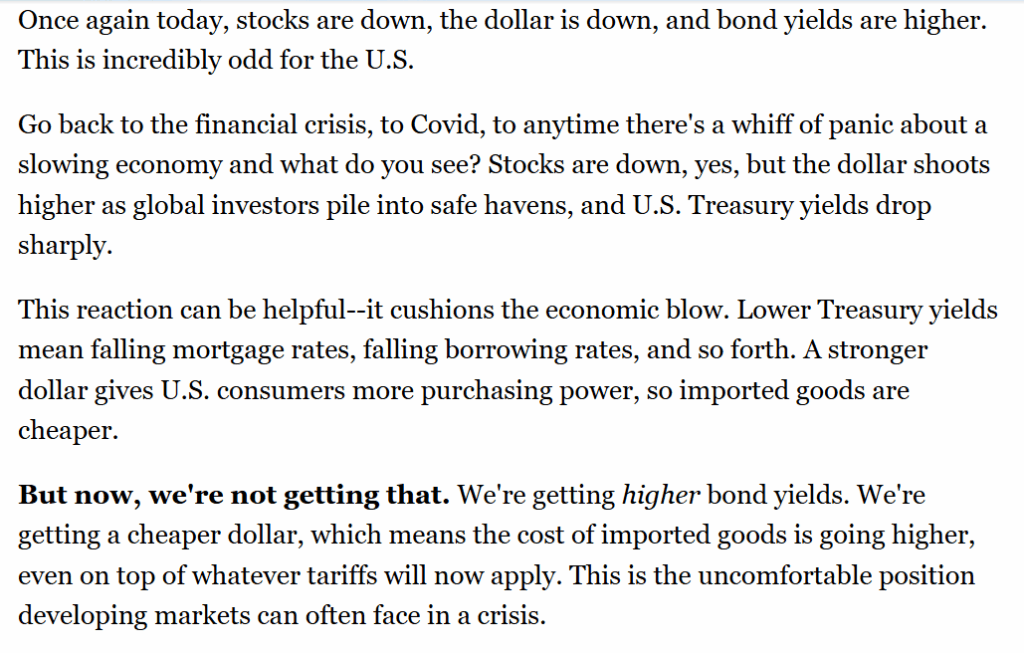
America is hemorrhaging trust. And this means investors are going to look elsewhere.
Why This Matters for Canada
As Canada’s relationship with the United States continues to deteriorate, it’s easy to see how this country will be negatively impacted.
However, it would be wise for Canada to view this as an opportunity.
There is still a lot of money in the world. If a portion of that money gets pulled out of the United States, it’s going to go somewhere. And while it would be unrealistic to think Canada can attract all of it, we can certainly attract some.
Investors and potential trade partners are looking for stability to offset the chaos emanating from Washington. In today’s environment, stability is becoming a premium asset, and it’s an asset Canada can not only provide but also amplify through its substantial natural resources, positioning the country as a top-tier investment destination.
Canadian Stability as a Premium Asset
Canada has a narrow window to establish and brand itself in such a way as to outcompete the United States for the trillions of dollars that could be up for grabs.
This would have seemed absurd even a few months ago, as Canada was widely seen as a sclerotic and overregulated nation, while the fast-growing U.S. economy was poised for continued success.
Yet, such is the scale of Donald Trump’s tariff folly that Canada has a once-in-a-generation opportunity to economically outflank the United States.
Foreign direct investment into Canada has begun to rise, modestly for now, but with room for acceleration.
Both Mark Carney and Pierre Poilievre command broader economic credibility across financial and business circles than either Justin Trudeau or Donald Trump, a perception reflected in polling and commentary from major institutional voices. Thus, Canada’s looming post-election period should be utilized as a sprint toward economic renewal under competent leadership, rather than a desperate retrenchment.
With deficits likely to persist regardless of the next government – campaign rhetoric notwithstanding – Canada must position itself as a stable, open, and pro-growth economy. Doing so could turn today’s fiscal constraints into tomorrow’s investment advantage.
Spencer Fernando
On Patreon, I create more content for a strong and sovereign Canada.
Prefer a one-time contribution? You can give via PayPal.