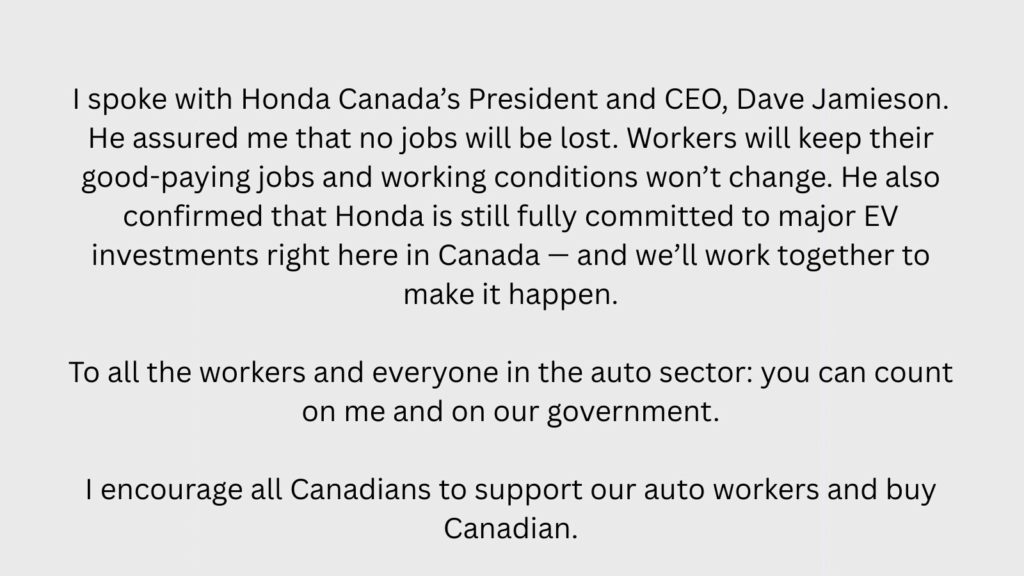
Newly appointed Industry Minister Melanie Joly recently released the following statement after Honda announced a pause in a planned $15 billion investment in shifting to EV production in Canada:
This is the latest in a growing list of closures, cutbacks, and rumours surrounding the Canadian auto sector amid U.S. tariffs.
In early April, Stellantis announced the temporary closure of its Windsor assembly plant.
In mid-April, Honda was forced to reply to rumours that its Alliston, Ontario, plant would be cutting capacity.
In early May, GM cut shifts at its Oshawa, Ontario plant.
Pervasive uncertainty
There is little sign this uncertainty will abate. U.S. tariffs are likely to remain to some extent, and chaotic U.S. trade policy is freezing investment, particularly in nations like Canada with deep U.S. trade ties.
We cannot control U.S. policy, but that does not mean Canada is without options.
And the option we should pursue is to shift a portion of the Canadian auto sector toward military production.
Agency & security
Such a shift, which would involve government cooperation with Canadian companies such as Roshel, would be geared towards ramping up production in the short term, while building a shock absorber that could scale up production if and when Canadian auto sector jobs are lost due to trade uncertainty.
In mid-April, I explored one way this could be done:
“Roshel, headquartered in Brampton, Ontario, has emerged as a key supplier of armoured vehicles to Ukraine, recently delivering its 1,700th Senator. This operational scale positions it as a logical anchor for an expanded domestic defence procurement strategy. A government order for 10,000 units to be delivered within two years, valued at an estimated $10–12 billion, would necessitate a significant ramp-up in production, requiring additional facilities and a likely tripling of its 500-strong workforce. With appropriate performance-based contracts and retraining subsidies, this investment could serve as a stabilizer for displaced auto workers while advancing Canadian defence readiness.”
Earlier on, in February of this year, I explained why this is of such strategic importance, for both the auto sector and steel/aluminum sector (also facing U.S. tariffs):
“Canada needs artillery shells, armoured vehicles, ground-based air defence platforms, small arms, drones, tanks, ships, and more, and we need them in large quantities.
We need to produce as much military equipment domestically as we possibly can, to avoid reliance on foreign countries.
Much of the military equipment we need requires large amounts of steel and aluminum. Building military vehicles, multi-use mobile platforms, and tanks will require auto factories and auto workers. Retooling those factories and training those workers will require investment.
This is something our government needs to be thinking about and planning for.”
Though much has changed politically since then, Canada’s strategic imperatives have not. This country still requires a large-scale military buildup, and we still need to protect core industrial capacity and jobs.
Germany, one of Canada’s NATO allies, is already moving in this direction, converting some shuttered auto factories to military production:
“The conversion of these factories is expected to mitigate production bottlenecks affecting Germany’s defence industry. Additionally, companies involved in this transition may benefit from the European Union’s proposed ReArm Europe fund, which, if implemented, would allocate over €800 billion to strengthening Europe’s defence capabilities.
Industrial giant Rheinmetall AG is reportedly considering acquiring Volkswagen’s Osnabrück plant. The company believes the facility could be adapted relatively easily for manufacturing combat vehicles, such as the KF41 Lynx infantry fighting vehicle.”
Canada could start by funding the expansion of existing Roshel production facilities, while setting aside contingency funds to purchase and retool factories from foreign auto companies if they slash production or shut down entirely. Workers would also be retrained, protecting jobs and ensuring a new military production workforce would have a solid experience base.
Canada has agency, and we can use it to further our security. And, unlike the significant government investment in the EV sector that is yet to pay off, expanding domestic military production would bolster Canadian sovereignty at a crucial moment.
The new government has portrayed itself as willing to think big, and ‘do things Canada hasn’t done before at a speed we never thought possible.’ Now, with the Canadian auto sector under siege, it’s time to make good on that rhetoric.
Spencer Fernando
Image – YouTube
On Patreon, I create more content for a strong and sovereign Canada.
Prefer a one-time contribution? You can give via PayPal.