The U.S. President says foreign countries pay the tariffs. That is not the case.
While U.S. President Donald Trump’s tariffs go against a century of hard-won economic wisdom, he has managed to sell them politically to a portion of the U.S. electorate by casting them as painless and near-magical instruments of wealth creation.
Repeatedly, Trump claims foreign countries pay the tariffs, giving the impression that Trump’s trade deals represent other countries giving money to the United States. Trump also claims tariffs will do two things simultaneously – boost domestic production by making imports more expensive, and use tariffs as a revenue tool for the government to reduce deficits.
Of course, if tariffs boost domestic production, it’s because they make imports more expensive and push people to buy domestically. This reduces import volume, which in turn decreases tariff revenue. Alternatively, if tariff revenue is stable, it means people are continuing to import rather than buy domestically.
These contradictions exist because they have to in order for Trump to sell his tariffs. If he were honest about how tariffs work – they represent a tax on Americans that is deliberately designed to make imported products more expensive – they would be impossible to sell to the U.S. electorate. Keep in mind that Trump’s tariffs are increasingly unpopular, despite his dishonest promotion of them.
And now, his favourite talking point – foreign countries pay the tariffs – is crumbling.
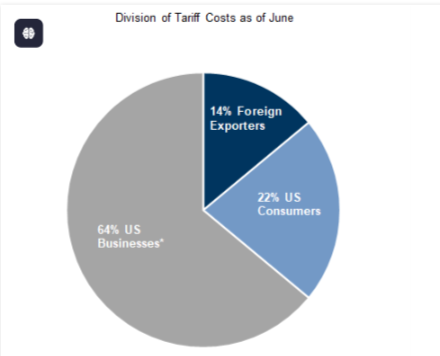
According to an analysis by Goldman Sachs, Americans are paying 86% of the cost of Trump’s tariffs, with just 14% being eaten by foreign companies:
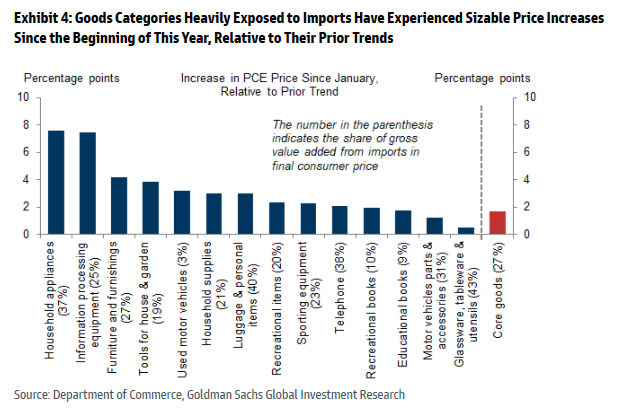
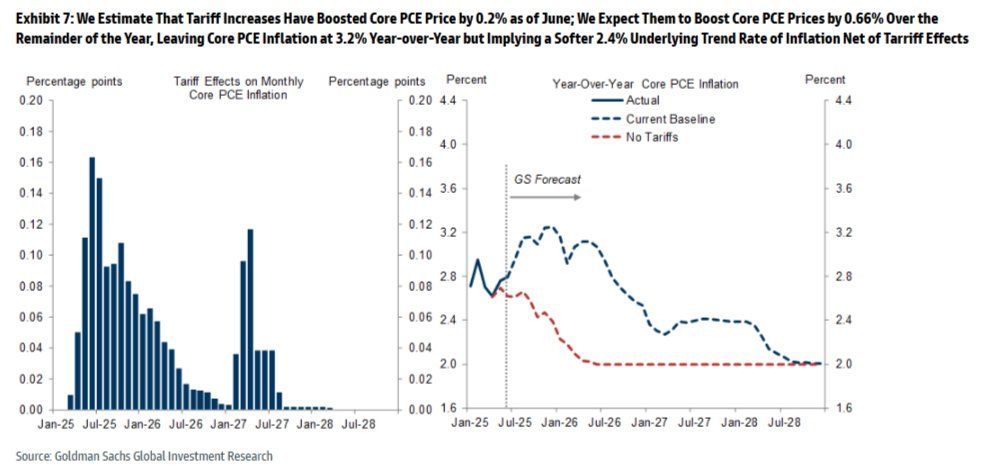
As you can see, tariffs are having the impact that the vast majority of economists predicted they would. They are driving up prices. And while some foreign exporters will attempt to eat some of the cost, there are limits to how much they can do that before it’s simply not worth exporting at all.
Tariffs are a tax
Another reason tariffs have been saleable is that many don’t realize they are simply a tax. Like a carbon tax, sales tax, or any other kind of government effort to raise revenue from transactions. Tariffs make things more expensive and direct revenue into government coffers.
Trump’s tariffs are no different. And – as seen above – they are making things more expensive for Americans. Again, none of this is surprising. This is what nearly every economist predicted would happen. And to the extent the impact of tariffs has been less than initially predicted, that is largely due to Trump repeatedly delaying tariffs and – in the case of Canada and Mexico – CUSMA exemptions that cover the vast majority of trade flows.
But now that Trump’s ‘deals’ are going ahead and tariffs are being fully imposed, the impact is going to increase, and it will be impossible to deny that tariffs push up the cost of living.
It is also important to recognize that by trying to direct economic activity to specific companies and sectors through the use of tariffs, significant economic distortions will develop. For example, American companies and consumers that purchase Canadian products do so of their own volition and because they feel it offers the best value. Tariffs may be able to change that behaviour, but that will, in many cases, redirect money to more expensive alternatives (if the alternatives were more affordable, many would already be using them), resulting in more money spent for no increase in goods.
This used to be something understood by many on the right, but that has flipped, given how many right-wing figures have set aside their principles and submitted to Donald Trump’s economic irrationality.
Spencer Fernando
On Patreon, I create more content for a strong and sovereign Canada.
Prefer a one-time contribution? You can give via PayPal.
My primary consideration when shopping for almost anything, is if it from the States. This shopping habit is now ingrained.