Soft power still matters, but Canada must pair it with credible hard power and a willingness to support our NATO partners.
This week has brought significant developments when it comes to Canada’s nascent military buildup and our role on the world stage.
To start, the government announced the two finalists for the construction of Canada’s replacement for the Victoria-class submarines. The government will choose either Germany’s Thyssen Krupp Marine Systems (TKMS) or South Korea’s Hanwha Ocean Co., Ltd. (Hanwha).
Type 212CD (Thyssen Krupp)
Thyssen Krupp is offering the Type 212CD, which Germany is co-producing with Norway. The Type 212CD is a much larger and more advanced version of the current Type 212 submarine:
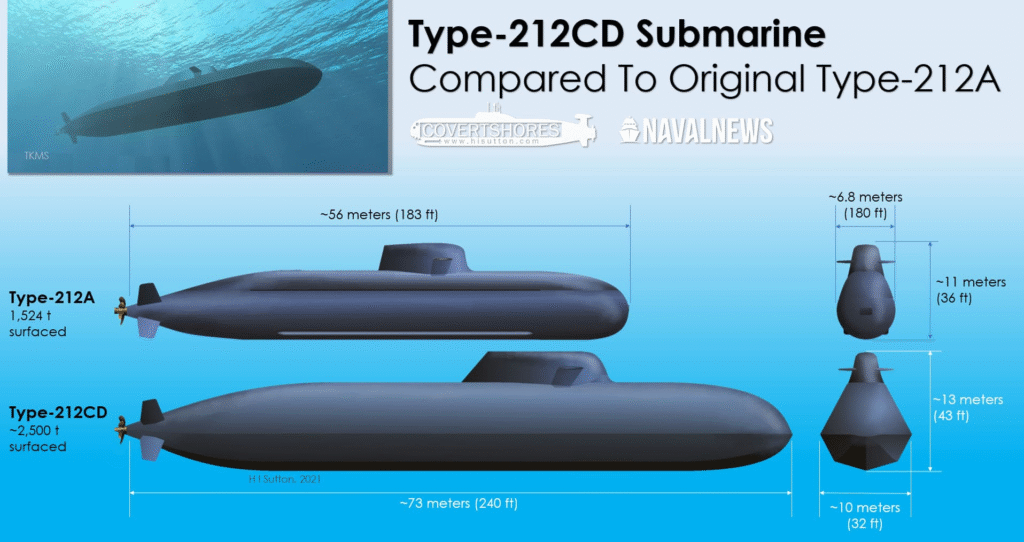
The submarine features a diamond-shaped hull to provide stealth characteristics and has an air-independent propulsion system. Armaments include four torpedo tubes, with options for utilizing air defence missiles.
Canada would become one of the largest operators of the Type 212CD, with the government planning to purchase 12 to complete the Canadian Patrol Submarine procurement. Germany plans to operate six, with three more to be ordered post-2035, while Norway will likely procure six.
Poland may purchase three, though four other submarines are part of their procurement competition.
KSS-III (Hanwha)
Hanwha is offering Canada the KSS-III submarine:
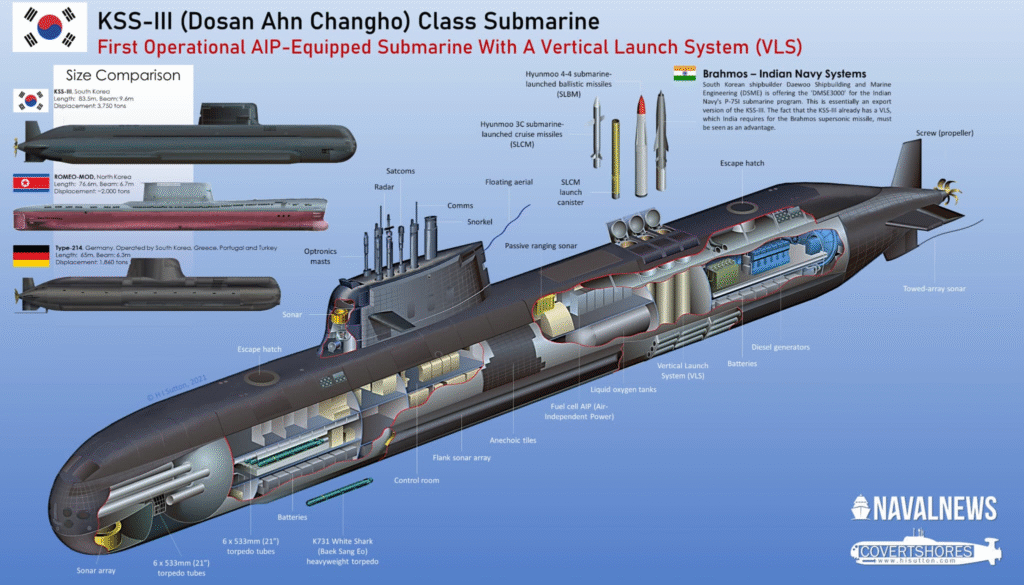
The KSS-III features an air-independent propulsion system, six torpedo tubes and six vertical launch system cells.
For comparison, the KSS-III has a range of 19,000 km, while the Type 212CD is said to have a range longer than that of the Type 212A (15,000 km). The Type 212CD has an endurance of 41 days, compared to an endurance of 20+ days.
The KSS-III is larger, with a displacement of 3,600 long tons submerged, a length of 89.3 metres (batch II), a beam of 9.6 metres, and a draught of 7.62 metres.
The Type 212CD has a displacement of 2,800 long tons submerged, a length of 73 metres, a beam of 10 metres, and a draught of 7 metres.
Both have a speed of 20 knots.
Whichever one Canada chooses, it would represent a significant improvement over the aging Victoria-class submarines, which have spent much of their time undergoing repairs and maintenance rather than being deployed at sea. Of course, since the government is targeting 2035 as the date for the first submarine delivery, we will need to supplement our minimal submarine capability with drones and alliances.
Still, moving forward with this procurement is important, as it demonstrates the government’s seriousness in turning Canada into a more robust military power. However, it was another announcement this week that went even further toward building Canada’s credibility with friend and foe alike.
Renewing Operation Reassurance
Operation Reassurance is the Canadian-led NATO presence in Latvia, one of the Baltic nations most at risk of being invaded by Russia. The operation was launched following Russia’s invasion of Ukraine in 2014, as a way to make it clear that NATO would not abandon the nations vulnerable to Russian aggression.
Canada currently has roughly 2,000 troops deployed in the country. Canada leads roughly 3,000 overall NATO troops. And now, Canada has announced the extension of the mission for three years. Prime Minister Carney framed the extension as a way for Canada to help secure the peace in Europe:
“To secure lasting peace in Ukraine and Europe, we must deter and fortify. For over a decade, Canadian troops have played an indispensable role in deterring Russian aggression on NATO’s Eastern Flank and fortifying our shared defence. Canadians can be proud that our troops will continue to lead Operation REASSURANCE in this critical mission – for greater security, stability, and prosperity in Europe and around the world.”
Canada’s leadership of Operation Reassurance provides us with a strong connection to many NATO partners, as we lead a brigade comprised of the following members:
Albania, the Czech Republic, Denmark, Iceland, Italy, Latvia, Montenegro, North Macedonia, Poland, Slovakia, Slovenia, Spain, and Sweden.
Sweden, Denmark, Latvia, Poland, and Italy are all influential actors in Europe due to their proximity to Russia’s borders, presence in the North (Denmark through Greenland), or overall economic and military heft (Italy and Poland). Had Canada stepped back from our leadership of the operation, we would be seen by many of our allies as leaving at a moment of maximum uncertainty.
Help others now, receive help later
At a time when some countries – particularly the United States – have chosen to act in a ruthlessly transactional manner, Canada’s extension of our Operation Reassurance leadership is a move in the other direction. By showing that we take our responsibilities as an ally seriously, Canada is in effect banking credibility. We are proving that we are willing to take a leadership role, and back that leadership with a real commitment of military personnel.
This matters because Canada could soon find itself asking for help from the same allies we are leading in Latvia.
In the North, we could face increasing Russian encroachment on Canadian territory, and the United States may either do nothing or even tacitly work with Russia in the North when it comes to exploring for energy. This would be viewed quite negatively by Canada and many of our allies, and we would be wise to invite those allies to station troops, ships, and planes in Canadian ground bases, air bases, and ports.
To be able to ask for help from others in the future, we must be willing to help our allies now. And that’s what we’re doing by extending Operation Reassurance.
Adjusting to a ‘hard power’ world
The previous Canadian government bet that the world would remain a safe place for nations that prioritized soft power. That bet was lost, with the U.S. becoming less reliable, instability rising across the West, revisionist powers like Russia and China emboldened, and timidity and wishful thinking in democracies giving autocracies a jump on rearmament.
In this kind of world, hard power is what matters most. When our allies consider our importance, they look at how many troops we can send, how many ships we have, and how many planes we can deploy. They look at our 155mm artillery shell production, our military industrial complex, our ability to adapt to drone warfare, and our willingness to put real resources and military assets to work for NATO’s collective security.
And NATO remains incredibly important, perhaps more important than ever. While the United States feels it has the luxury of questioning NATO, a strong NATO is literally existential for nations like Poland, Latvia, Lithuania, and Estonia. Without NATO, some, if not all, of those nations would have been invaded by Russia. NATO is a shield, a way for those countries to secure their places as free, democratic nations empowered to choose their own destiny.
And the same is true for Canada. Without NATO, Canada would be much more vulnerable. If the U.S. stepped back from military cooperation or allied with nations like Russia and China, we would end up needing support from our European allies, the same allies we are helping now. This also extends to utilizing our natural resources (particularly LNG) to help Europe reduce dependence on energy from authoritarian nations like Russia.
So, while Canada has a long way to go in the process of rebuilding our hard power, extending our leadership of Operation Reassurance is another step in the right direction, just as moving towards a final purchase of submarines showcases a level of seriousness that has long been lacking.
Spencer Fernando
Image – YouTube
On Patreon, I create more content for a strong and sovereign Canada.
Prefer a one-time contribution? You can give via PayPal.
J. Trudeau did a tremendous amount of damage to Canada in many areas. Physically, economically, socially and politically. We might never completely recover.