China’s massive shipbuilding program and impending need to ‘protect’ Arctic shipping routes mean a larger Chinese military presence in the region is inevitable. Canada can deal with it from a position of strength or be caught off guard militarily, as we have been for far too long.
China, despite being quite distant from the Arctic, calls itself a ‘near-Arctic state.’ This is due to China’s long-term economic interests in the region and the fact that few nations have the raw power to dispute China’s entry into the region.
China is currently engaged in the largest naval expansion since the Second World War. As reported by the BBC, between 2019 and 2023, China’s four largest shipyards produced naval vessels with a tonnage larger than the entire British Navy:
“Between 2019 and 2023, China’s four largest shipyards – Dalian, Guangzhou, Jiangnan and Hudong-Zhonghua – produced 39 warships with a combined displacement of 550,000 tonnes, according to a study by the Center for Strategic and International Studies (CSIS).
That is the volume of water they displace, which is the most common way of measuring the size of a vessel or fleet. In comparison, the UK’s Royal Navy currently has an estimated total displacement of around 399,000 tonnes.
While China has the world’s largest navy by number of vessels, the US fleet has a greater overall tonnage and is more powerful – with far more large aircraft carriers.
But Beijing is catching up.
“There’s no sign that the Chinese are slowing down,” says Alexander Palmer from the CSIS and author of the report, Unpacking China’s Naval Buildup.
“Hull count [number of ships] is not the only measure of a navy’s effectiveness of course, but the ability to produce and churn out warships has been extremely impressive and could make a strategic difference.”
Polar Silk Road
China’s naval buildup is matched with its move toward further commercial shipping on the Northern Sea Route (AKA the ‘Polar Silk Road’):
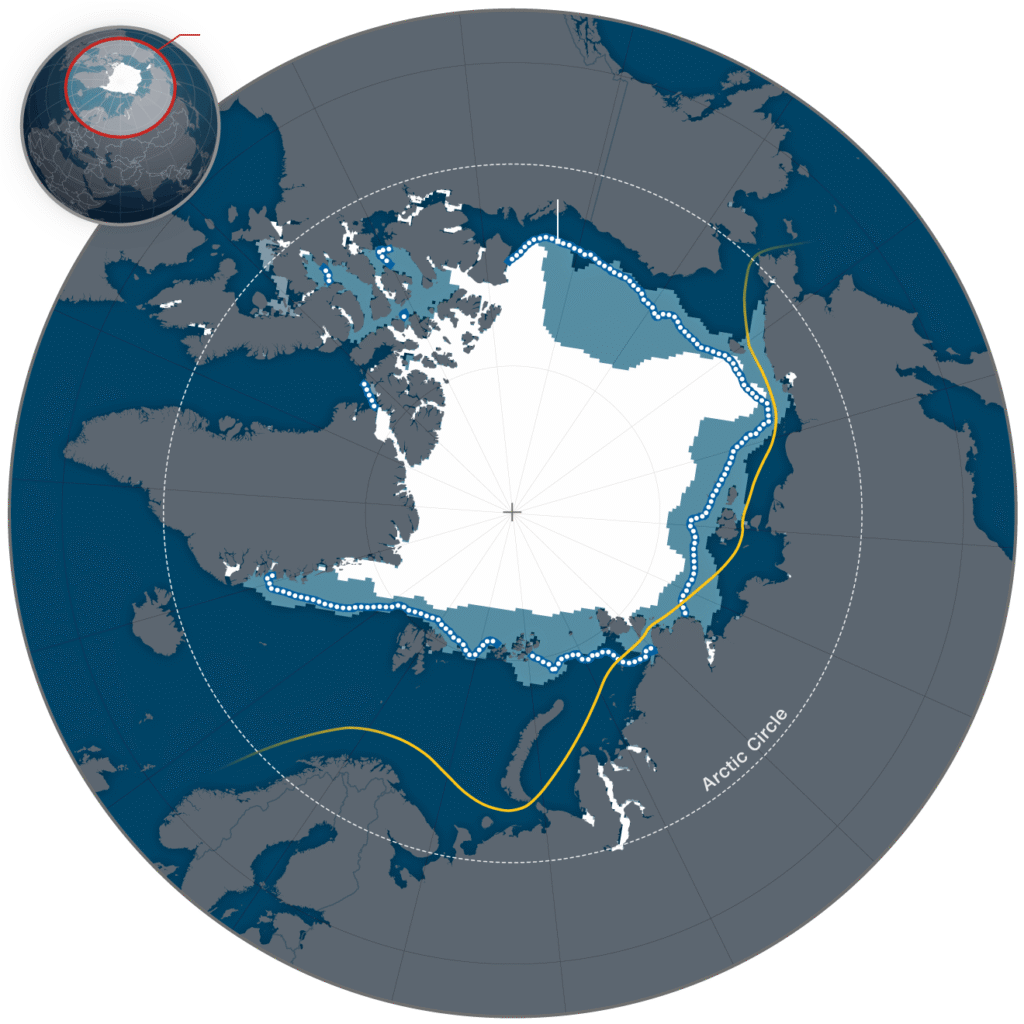
With melting sea ice opening up shipping in the region, China is seeking to be a dominant player. And just like every major naval power, China will match commercial shipping with a military presence to ‘protect’ key shipping routes. While Canada is not directly on the Polar Silk Road, China will no doubt seek to question Canadian territorial claims in the North if it suits their interests, and their navy will move closer and closer to Canadian territorial waters.
There is no way out of the game
Increased economic activity and military activity in the north is inevitable. We can either play the ‘game’ well or play it poorly, but there is no way out of playing. If Canada doesn’t enhance its presence in the North, we could find our Northern region under our control only on maps, with real power resting in the hands of the United States, Russia, and China. Thus, if we want to preserve and enhance our sovereignty, a military expansion – including the construction of air bases, naval bases, land bases, and the expansion of instructure in the North is essential, as is mass-producing drones that can give us a robust presence in the region before longer-term big-ticket acquisitions of submarines and River-Class destroyers are complete.
Canada has been blessed with an immense amount of territory. But holding on to control over it is not guaranteed. We are going to have to work for it, and that means investing in Canada’s Armed Forces.
Spencer Fernando
Image – YouTube
On Patreon, I create more content for a strong and sovereign Canada.
Prefer a one-time contribution? You can give via PayPal.