The steam engine couldn’t be uninvented. Oil was always going to generate massive economic gains. Electrification was inevitable once it began. The internet reshaped (and continues to reshape) our economy, whether people like it or not.
Profound technological changes are part of a larger process of human knowledge acquisition and implementation, an evolutionary process that is larger than any one person, nation, ideology, or even civilization.
Thus, it is irrational to talk about ‘stopping’ or ‘resisting’ AI, because to do so would mean trying to resist human evolution itself.
Utopia within reach?
While many dystopian visions of the future have been spread throughout countless books, movies, shows, and video games, such a future is not inevitable. AI is often paired with dystopian visions, but AI helping to move us closer to a ‘utopia’ is just as achievable, and its foundation can already be seen.
Utopian visions of the future often centre around nearly limitless abundance, the absence of poverty, and the widespread diffusion of advanced technology. Humans are ‘freed’ from needing to pursue physical labour due to the use of hyper-efficient machines, and ‘knowledge-work’ is widely assisted by computers that follow our verbal commands with ease.
Yet, this is not some distant and abstract fantasy; it already describes a significant portion of the global economy. While manufacturing jobs have been lost in part due to outsourcing, rising productivity due to automation accounts for a significant portion of the shift.
As you can see in the following charts, manufacturing in Canada is far more productive than it was in the past:
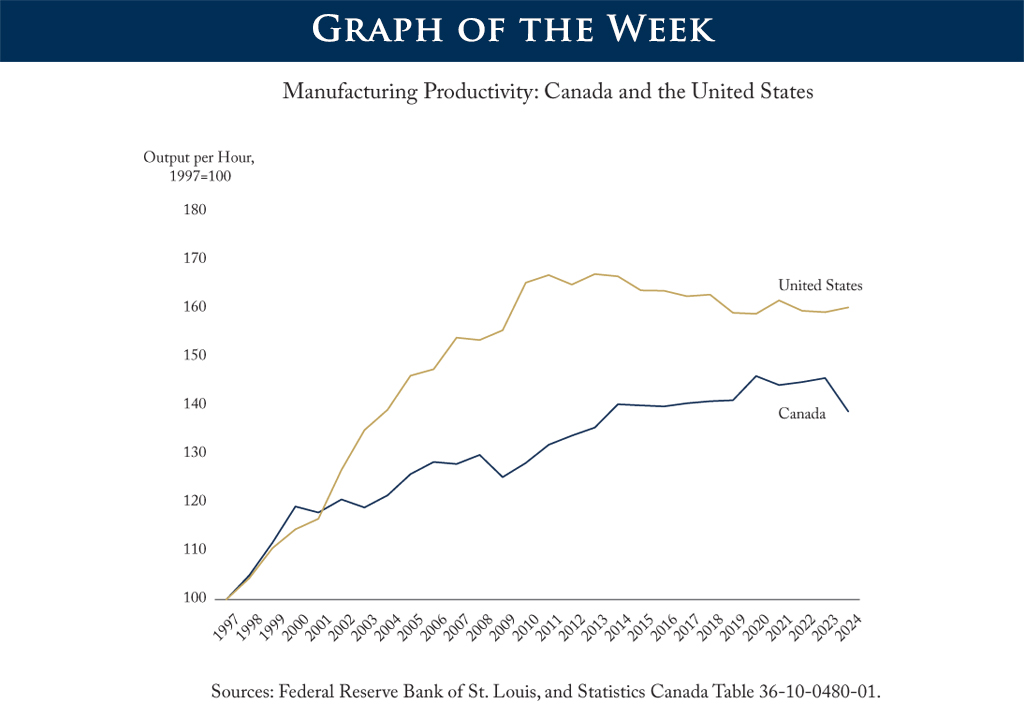
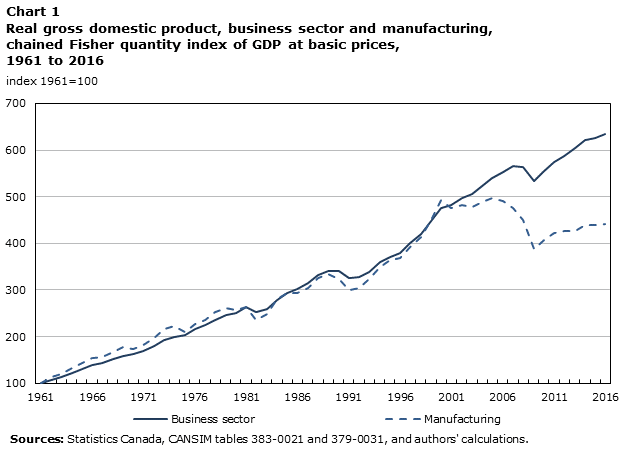
Manufacturing’s ‘decline’ is relative. We can produce more with fewer workers, and that means growth in the service sector was inevitable as a critical mass of goods relative to people was produced at a more efficient pace. However, the service sector is now being disrupted by AI. Physical automation is now increasingly being paired with intellectual automation.
A larger portion of the workforce does jobs where little physical movement is required, and while prices of many goods have gone up in recent years, the cost of computing power has collapsed:
Laptops, mobile phones (considering all their capabilities), and other tech-based consumer products have seen dramatic price deflation. Widespread adoption of AI and AI-assisted robotics (the two are intrinsically linked) will cause similar declines in the cost of many other consumer goods.
We are thus trending towards significant deflation in prices, combined with massive productivity increases and the reduction of the need for human labour. While this will cause significant challenges, a combination of lower prices and taxation of large tech/robotics companies will likely fund some sort of basic income. Cheap and abundant goods combined with strong social welfare will bring us closer to a future that existed only in the realm of science fiction.
The awkward transition
If we are potentially heading towards a hopeful future, why do things often feel so terrible? Because we are in the awkward transition phase, like the phase when growing your hair long looks awful for a while. The lost jobs and social upheaval precede the massive productivity gains, and it’s always easier to see the decline of existing industries than it is to imagine the industries that will replace them. Further, we are still figuring out the balance between regulation and taxation of large tech companies, and productivity gains are not currently high enough, nor has massive deflation set in, meaning we can’t afford widespread social welfare that would offset the disruption.
This will be a difficult moment, because much will be lost, even if much more will be gained in the long run. And such a moment requires leaders with foresight who can acknowledge real fear and real concern without exploiting it.
Embracing the opportunity
We can view this future with fear, or we can view it with optimism. A world of abundance and freedom is well within reach. And crucially, Canada is among the best positioned to lead this future. The adoption of AI requires large, energy-intensive data centres. Cooling costs and raw energy input costs are immense. Canada offers cold weather, abundant energy (whether through efficient hydro power in the East or massive oil & gas reserves in the West), and has a highly educated, tech-savvy population. In fact, if you were designing a country from scratch to become a world leader in AI, that country would look a lot like Canada.
To make the most of this opportunity, we need an abundance mindset, not a scarcity mindset. We need to develop our natural resources, encourage talented tech workers to come to Canada, make sure we avoid overregulating the sector, and keep business taxes competitive. Most importantly, we cannot give in to populist voices on the left and right who will advocate for restricting the use of AI to ‘protect’ jobs. Such voices will find enthusiastic audiences as the pace of disruption picks up, but such a course of action would lead to Canada becoming poorer, since countries that don’t embrace AI will simply fall behind those that do. If Canada fails to embrace the mass adoption of AI, fails to embrace robotics, and fails to create a positive business environment for Canadian tech entrepreneurs, investment, wealth, and innovation will move elsewhere.
In an era of rapid and profound change, let’s ensure that Canada makes the most of the opportunity before us and embraces AI to the greatest extent possible, rather than giving in to those who are motivated by fear of the future. While it’s tempting to hold on to what already exists, it is little more than a comforting illusion that holds us back.
Spencer Fernando
On Patreon, I create more content for a strong and sovereign Canada.
Prefer a one-time contribution? You can give via PayPal.