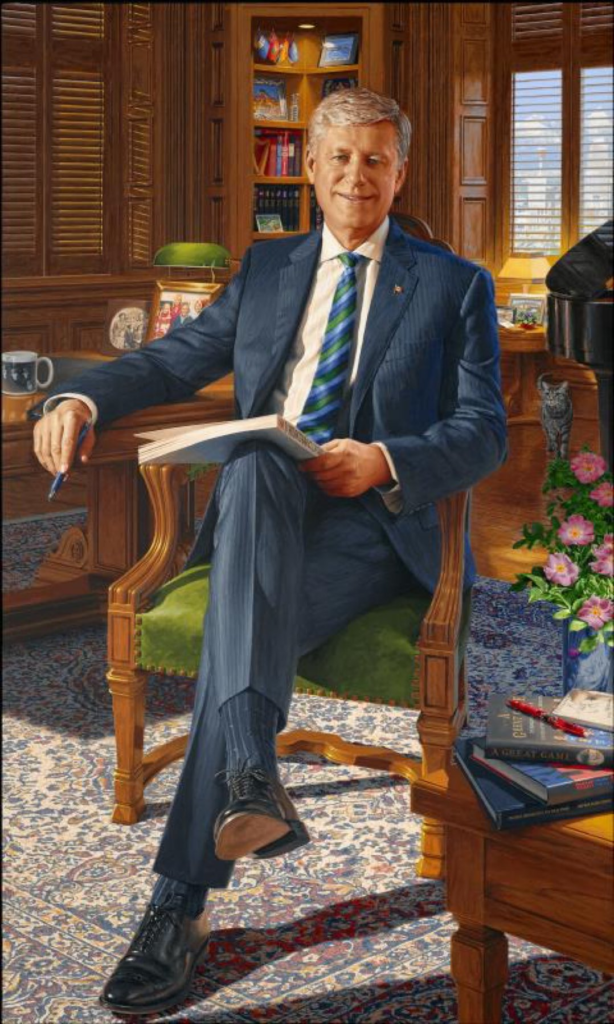
Canada’s 22nd Prime Minister understands what is at stake and recognizes that excessive internal division is something Canada can’t afford amid growing external threats.
Former Prime Minister Stephen Harper’s official portrait has been unveiled:
In his remarks following the unveiling, Canada’s 22nd Prime Minister struck a sober and unifying tone, and clearly sought to convey the gravity of the moment Canada finds itself in as a nation:
Stephen Harper ended his speech with a call to unity #cdnpoli
"In these perilous times, both parties, whatever their other differences, come together against external forces that threaten our independence and against domestic policies that threaten our unity" pic.twitter.com/DFee7a8h2j
In his 2018 book Right Here, Right Now: Politics and Leadership in the Age of Disruption, Harper wrote about the “Anywheres” and the “Somewheres.” The “Anywheres” were those who could live and work virtually anywhere, and who often travelled from place to place and thus built an identity more around the idea of cosmopolitanism. By contrast, the “Somewheres” tend to spend much of their lives in the same community and have more of an identification with their country and/or specific community.
While this way of looking at things still has some salience, there is a more significant divergence in Canada at the moment: The Understanders and the Normalizers.
The Understanders are those who recognize that the United States has fundamentally changed, that Donald Trump poses a real risk, that threats to Canada’s sovereignty cannot be dismissed, and that the survival of Canada is no longer a foregone conclusion. The Normalizers are those who believe that the United States either hasn’t changed or will soon go back to normal, and that any such threats from Trump or the Trump Administration are nothing more than empty words.
Most Canadians are in the Understanders group, as evidenced by Trump’s immense unpopularity in Canada and the collapse in how Canadians view the U.S. However, the Normalizers group is largely concentrated on the right of the political spectrum, with the Conservatives split. That’s why Harper’s words and example are so important at this crucial moment:
“I sincerely hope that mine is just one of many portraits of Prime Ministers from both parties that will continue to be hung in the Parliament of Canada for decades and centuries to come […] but that will require that in these perilous times both parties whatever their differences, come together to preserve the independence and unity of this blessed land.”
I sincerely hope that mine is just one of many portraits of Prime Ministers from both parties that will continue to be hung in the Parliament of Canada for decades and centuries to come […] but that will require that in these perilous times both parties whatever their… pic.twitter.com/FcOhtTNFkV
Just as Harper was one of the first to grasp the reasons for and implications of a surging global populism, he was also ahead of the curve on the need for Canada to take the threat to our sovereignty from the United States seriously, proclaiming all the way back in February of last year that we must be prepared to “accept any level of damage to preserve the independence of the country.”
Harper’s understanding of the threat Canada faces, his credibility with the Conservative base, and his status as an experienced national leader all make him a powerful defender of Canadian sovereignty. He sets an example of patriotism and strength at a time when Canada needs all the patriotism and strength we can muster. And in his exhortation for Canadians to put political differences aside, he shows how we can bridge partisan divides to come together as a nation. You’ll note that he referred to the need to “come together against external forces that threaten our independence and against domestic policies that threaten our unity.” That sentence contains an important message for both the right and the left, with the right needing to avoid doing the bidding of annexationist forces in the Trump Administration, and the left needing to be supportive of the Western Canadian energy sector to help tamp down separatist movements.
Stephen Harper may no longer be Prime Minister, but he remains a pivotal figure in Canada, and he continues to provide national leadership when it is needed most.
Spencer Fernando
Image – Twitter
On Patreon, I create more content for a strong and sovereign Canada.