This is what a high-trust, pluralistic democracy looks like. It took generations to build and would not be easy to rebuild if lost.
In a 1957 campaign document, then-Progressive Conservative Party Leader and soon-to-be Prime Minister John Diefenbaker was quoted as saying, “We must bring to Canadians a faith in their fellow Canadians and a faith in the future and destiny of this country.” It was but a glimpse of Diefenbaker’s expansive ‘One Canada’ vision, a vision that he would put into practise in government. In 1960, as he promoted the Canadian Bill of Rights, Diefenbaker said “I will declare the principle that every individual, whatever his colour, race or religion, shall be free from discrimination and will have guaranteed equality under the law.”
That same year, the Diefenbaker Government expanded the reach of Canadian democracy: “The Diefenbaker government’s key achievement in Aboriginal affairs was the extension of the franchise (or the right to vote) in 1960. First Nations people before this time, as federal “wards” were not allowed to vote in federal elections. Following the two World Wars, veterans were enfranchised, but only if they gave up their Indian Status – only 250 voluntarily accepted the offer. Diefenbaker felt strongly about providing all First Nations people the right to vote, as was his government, especially Senator James Gladstone (the first Aboriginal person appointed to the Senate). In 1960, his government changed the section of the Indian Act which denied First Nations people the vote.”
While this was but one step in seeking to correct historical wrongs and achieve greater reconciliation (a process which is still ongoing), Diefenbaker’s belief in expanding the right to vote foundation piece that made the Canada of today possible. Diefenbaker’s words still have resonance in the modern era, and are a reminder that building a successful civilisation and a successful nation takes tremendous patience. Many people – who, unlike Prime Ministers, often go unrecognised – play the long game over decades and centuries, building institutions that help trust compound over time.
A young nation with a durable government
Canada is often described as a ‘young’ country. We often think of ourselves this way, and contrast our relative ‘newness’ in the world with long-standing nations like France, Japan, Germany, Italy, and others. However, when we look at the unbroken continuity of government, Canada stands out as having one of the oldest and most stable governments on the planet. Since 1867, Canada’s government has operated continuously, without being overthrown by an invasion, without a coup, and without a revolution. By contrast, France went through multiple Republics during that time and was occupied by Germany in the first half of the 1940s. Germany went through several revolutions and was ultimately reorganized by the Allies following the Second World War. The same occurred in Japan, while Italy – having already undergone a revolution in the 1920s – then revolted against Mussolini as Allied troops made advances in the South in 1943 – before voting to become a Republic in 1946. And of course, wars, revolutions, coups, and independence movements were widespread in the latter half of the 20th Century. As a result, nearly every government on Earth (with exceptions like the United Kingdom and the United States) is younger than Canada’s.
A country where ideas and character matter more than where you were born
This continuity has endured as Canada has continued to broaden our sense of what it means to be Canadian, a broadening embraced by leaders of different political stripes. For example, in July of 2022, a key part of Conservative Leader Pierre Poilievre’s message was the phrase “It should not matter where you come from, but where you are going,” an appeal focused on the idea that our common desire to live a good and prosperous life matters more than the circumstances of our birth. Along similar lines, while speaking in Australia this week, Prime Minister Mark Carney cited Canada’s belief that “unity does not require uniformity,” and that Canada is a strong nation without demanding everyone adhere to a singular identity:
CARNEY: “Canada’s founding insight is that unity does not require uniformity. That we can share a country without conforming to a single identity. That our differences, honestly acknowledged and respectfully navigated, are a source of strength.”
In those remarks, Carney also praised Australia for being the first nation to extend the franchise to Women. That action – which inspired other nations – can be seen as a manifestation of the same impulse to extend rights and liberties that motivated John Diefenbaker. And when we look further back, we can see the deep roots of that impulse in our ‘ancient English liberty,’ as Pierre Poilievre eloquently explained in a recent video:
Canada: A diverse, high-trust society
While remaining aware of the real challenges Canada faces, we can also take pride in having built a diverse, high-trust society. A new public opinion survey from the Pew Research Center shows just how much Canada stands out when it comes to our belief in the goodness of our fellow citizens:
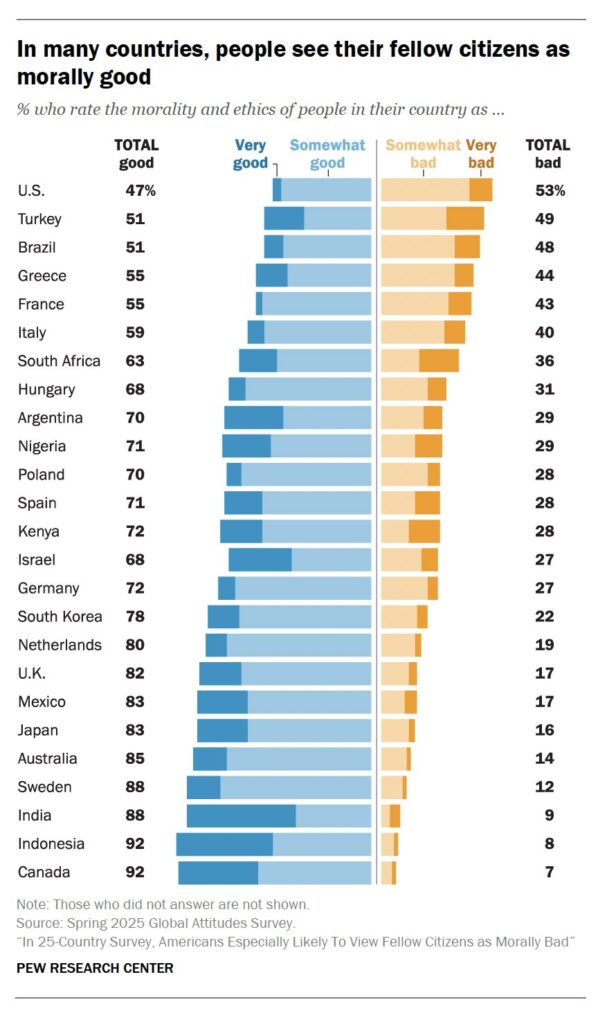
As Canadians, we are stewards of a legacy handed down through the Magna Carta, through those who fought and died for human freedom and dignity, through leaders and citizens across the political spectrum who worked to expand democracy and rights, and through the countless people of every background who helped sustain Canada as a strong, stable, and free nation. Our high level of trust in one another is the foundation they built. What we build upon it is the legacy we leave.
Spencer Fernando
Work like this is only possible with the support of readers who believe clear thinking about Canada’s future is worth sustaining. If that’s you, consider subscribing here.
On Patreon, I create more content for a strong and sovereign Canada.
Prefer a one-time contribution? You can give via PayPal.