The United States possesses the world’s greatest combination of hard power and soft power. As China catches up in the former, the Trump Administration seems determined to squander the latter.
As someone who is a big fan of the United States and is disturbed by the prospect of a more China-dominated world order, I am disappointed to write the following column.
But I fear the United States is trading short-term displays of bullying & dominance for a long-term loss of soft power, which will in turn lead to a loss of U.S. hard power – all to the benefit of Communist China.
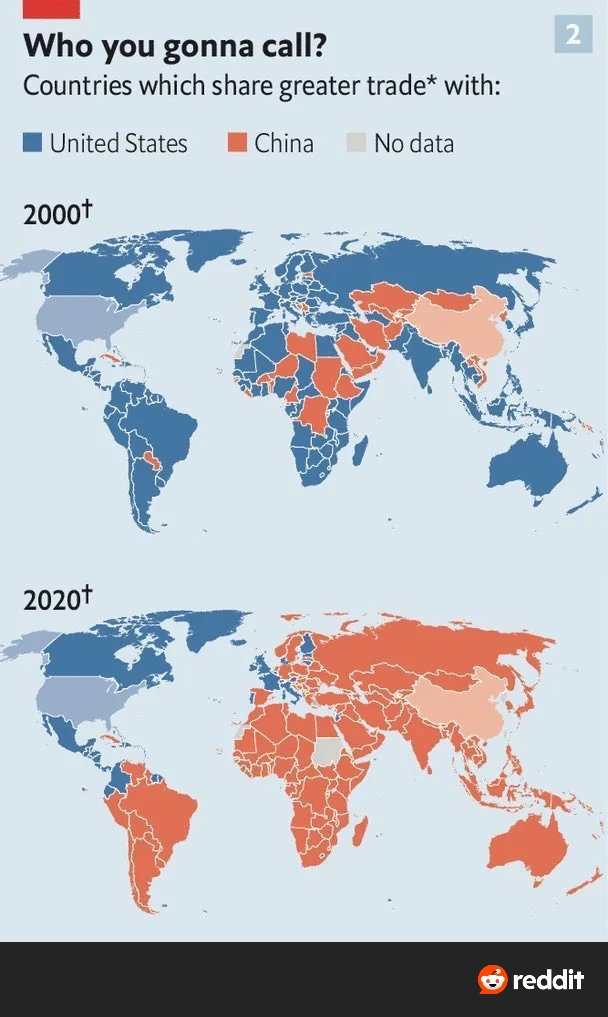
Let’s start by considering the following image shared by Tristin Hopper, depicting countries that had a greater share of trade with either the United States or China in 2000, and 2020:
“Was looking at this and realized that the handful of countries which haven’t switched their trade allegiances to China also happen to be the ones Donald Trump is most relentlessly bullying right now.”
Was looking at this and realized that the handful of countries which haven't switched their trade allegiances to China also happen to be the ones Donald Trump is most relentlessly bullying right now. pic.twitter.com/c8WHg51jjC
Compared to China, the U.S. is much less influential in world trade than they were 20 years ago. The military gap between the United States and China is also narrowing.
“By 2027, in areas west of the international dateline where U.S. assets are deployed, China will outnumber U.S. forces about 12 to 1 in modern fighter jets (including 5 to 3 in fifth-generation aircraft) and 3 to 1 in maritime patrol planes.
Speaking from the base theater to both an in-person and virtual audience, Brig. Gen. Doug Wickert, commander of the 412th Test Wing, at Edwards AFB, during the Monday’s Back-in-the-Saddle Day, held on Jan. 6, 2025.”
China also recently unveiled two new stealth aircraft.
“DeepSeek launched a free, open-source large language model in late December, claiming it was developed in just two months at a cost of under $6 million — a much smaller expense than the one called for by Western counterparts. Last week, the company released a reasoning model that also reportedly outperformed OpenAI’s latest in many third-party tests.”
“These developments have stoked concerns about the amount of money big tech companies have been investing in AI models and data centers, and raised alarm that the U.S. is not leading the sector as much as previously believed.
“DeepSeek clearly doesn’t have access to as much compute as U.S. hyperscalers and somehow managed to develop a model that appears highly competitive,” said Srini Pajjuri, semiconductor analyst at Raymond James, in a Monday note.”
Of course, China has its own serious challenges, including a severe demographic crisis and a massive buildup of debt.
Unfortunately, America’s demographic and financial advantages could be eroded if the country heads in an anti-immigrant (contrasted with responsible immigration) direction, and if the Trump Administration tries to use tariffs to replace domestic sources of incoming and blows up the already-massive U.S. budget deficit in the process.
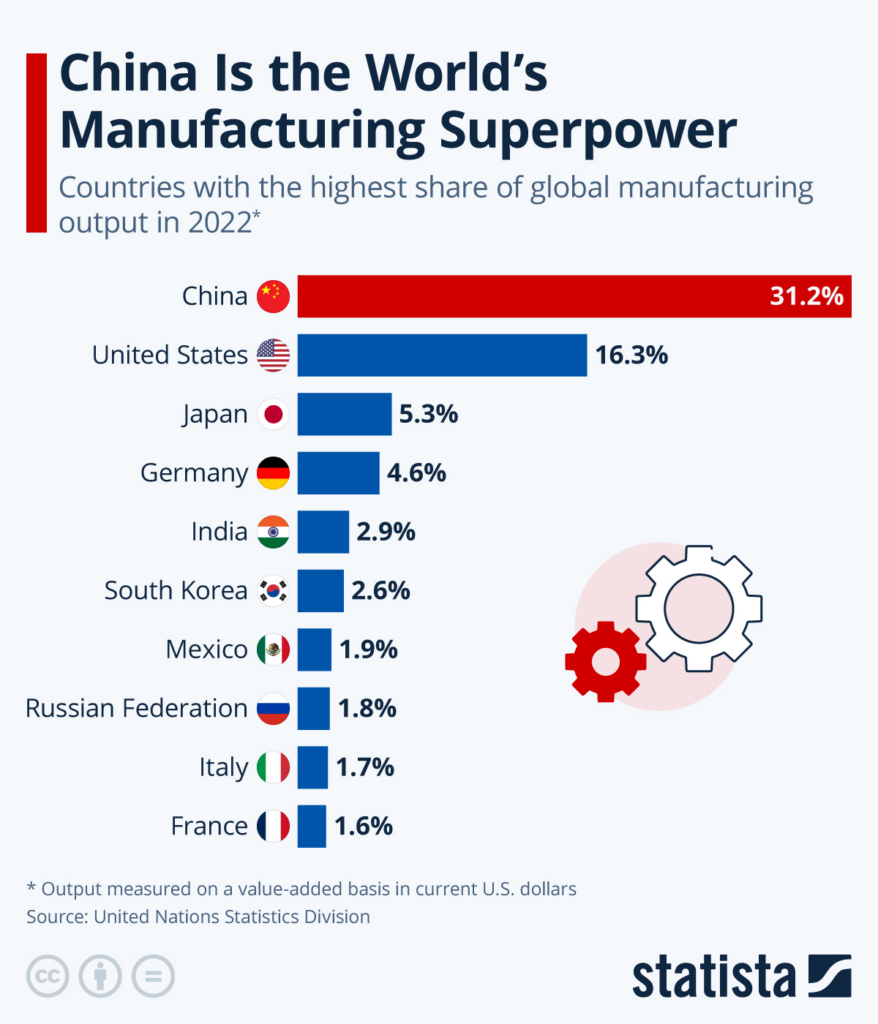
China also has a huge manufacturing advantage – something that would come into play in the event of a massive global conflict:
If the U.S. wanted to erode China’s advantages, there are some relatively easy ways they could do so.
First, continue to impose tariffs on China.
Second, offer allies a deal if they also impose tariffs on China – a deal that would include deeper trade and defence ties between the U.S. and allied nations.
Third, demonstrate that the U.S. is a trusted partner and that deals signed with the U.S. can be counted upon.
Fourth, utilize U.S. cultural and political soft power (American culture is the most influential in the world), to make siding with the U.S. look like a mutually beneficial arrangement.
Fifth, contrast American diplomacy with Chinese coercion. People will much rather side with those who offer them a choice than with those who offer threats.
These five steps would help strengthen American soft power, which would lead to gains in hard power at China’s expense. If more and more democracies tariff China while deepening their trade ties with each other, and if defence cooperation deepens, the U.S.-led world order would be a far more attractive option than a China-led world order.
While this approach may not provide gratifying ‘soundbites’ in the short term, it would strengthen the U.S. – and the free world – in the medium to long term.
Short-term gain for long-term pain
Unfortunately, the United States appears to be taking an approach that will lead to long-term damage to the power and influence of the United States, while benefitting China.
Many will be surprised to hear this because the United States appears to be more powerful than ever.
U.S. President Donald Trump dominates the headlines.
Foreign leaders wait to see which country will be threatened next.
Internal divisions are exacerbated by U.S. pressure.
Everyone is scrambling to appease the U.S. and hopes to avoid being the next target of Trump’s wrath.
American allies – smaller and less powerful than the U.S. – are (in the minds of some) finally being ‘put in their place’ and ‘brought to heel’ by the U.S. Administration.
The problem is that we are in the “sugar high” phase of American power.
The U.S. has undeniable advantages over its allies. They are using those advantages to coerce, threaten, and bully U.S. allies into doing what the U.S. wants. The U.S. is threatening to take Greenland from Denmark. The U.S. is threatening economically destructive tariffs on close allies like Canada. The U.S. is raising doubts about whether it’s committed to NATO. The U.S. – and influential Americans like Elon Musk – are intervening in European politics to try and elect far-right parties, something that is rapidly pushing Musk’s favorability ratings down in Europe.
America has adopted a purely transactional and extractive approach to dealing with allies. Rather than offering mutually beneficial agreements, the U.S. first threatens to destroy what currently exists, and then maybe give back some of it if you do what the U.S. wants.
It’s not a ‘win-win’ deal, it’s a win-lose deal.
Remember, the U.S. President – the leader of a nation that is supposed to be a Canadian ally – is openly talking about wrecking our economy to force us to give up our sovereignty. The leader of the U.S. is seeking to bring about the end of Canada as an independent nation.
Many watching this see America exerting power and see evidence of America’s strength.
Of course, this is how sugar highs work. You feel tons of energy and power until you crash.
And America’s current approach risks a long-term crash in American influence.
Human nature
People don’t like being threatened or coerced.
And people don’t like having the sovereignty of their nation questioned.
Of course, people can also understand power dynamics.
The leaders of American allies understand that America can largely get what it wants in the short term.
But even when the leaders of bullied nations agree to what America wants at the moment, efforts will be accelerated to reduce dependence on the United States.
We already see this here in Canada, where – aside from a small pro-Trump fringe that wants Canada to be annexed – there is a society-wide agreement that we must reduce our dependence on America as quickly as possible.
Over time, this demand from Canadians for less reliance on the U.S. will be translated into policy, leading to a Canada that proportionally trades less with the U.S. than with other countries, and which is more independent in terms of military procurement. We will buy less U.S. equipment, and most likely have deeper defence ties with Europe (in addition to maintaining our important ties with the U.S.).
The same will be true of European countries. Europe will become less dependent on trade with the United States and will purchase less U.S. military equipment.
Other countries – like Japan, South Korea, Taiwan, and Australia – may start to hedge their bets just a bit regarding the U.S. and China. If the U.S. can’t be relied upon, then some countries will feel pressured to start making deals with China, being uncertain of U.S. intentions and unable to rely on U.S. help in the case of a conflict.
Further, trust in America will erode.
After all, Canada’s free trade deal with the United States is still in force. Yet, we are learning this deal – with Trump’s signature on it – means nothing.
Likewise, other U.S. allies like the United Kingdom, Denmark, and Canada – were part of invoking NATO’s Article Five (an attack on one is an attack on all), after 9/11 and joined the U.S. in Afghanistan. We were good allies when it mattered most.
But if all of that counts for nothing because the U.S. President decides on a whim to punish and bully America’s friends, that will dissuade countries in the future from wanting to assist the U.S.
After the sugar high of bullying people wears off, Americans will find it far more difficult to influence other democracies in the future. And by being forced to distance themselves from the U.S., America’s allies will become far less vulnerable to U.S. pressure in the medium to long term.
American vulnerability
To a certain extent, America’s current belligerent posture towards allied nations indicates not strength, but vulnerability.
America has a mounting debt problem (they are spending more on debt service than on their military), and bullying their friends could erode America’s ‘exorbitant privilege’ (their ability to borrow at cheap rates because the U.S. Dollar is the world’s reserve currency). To address that debt problem America would need to achieve near-impossible levels of economic growth, or (more realistically) raise taxes and cut spending simultaneously. Nobody will do that since austerity isn’t a winner at the ballot box, so the debt problem seems set to worsen.
And if China is indeed not only exceeding the United States in terms of quantity but also quality in areas like artificial intelligence and advanced military production, the U.S. will need all the friends it can get.
Sadly, all of this presents a significant opportunity for China. China can sit back and again in terms of relative military power vis-a-vis the U.S. China can offer ‘win-win’ deals to countries bullied by the U.S. (accepting those deals would be a big mistake of course). And China can erode America’s moral advantage by pointing to American threats of economic destruction and territorial conquest against American allies.
None of this is reversible of course.
The great strength of the U.S. political system – and the strength of every democracy – is that change and renewal are never far away. Trump could be all bluster (though assuming that would be foolish), the system could limit the damage he does to U.S. relationships with its allies, and a global crisis could bring America and its allies closer together out of necessity and shared values. America still retains immense cultural power, military strength, and economic might. There are many admirable Americans, and the spirit of the American People cannot be erased regardless of who the President is. Even I, as a Canadian who is deeply disturbed by the actions and rhetoric of the current U.S. President and as someone who believes Canada must significantly reduce our reliance on the U.S. – still respect America and still hope Canada and America remain close allies in the future.
Still, the sense of destabilization and vulnerability many people in nations allied to America are feeling will not soon be forgotten. A critical lesson is being learned, and that lesson is that the U.S. is less reliable than we assumed. That’s not all on the U.S. of course, as it’s a mistake for any nation to assume that another country (even one that has been as strong and generally benevolent as the U.S.) would remain the same forever), and it’s a mistake to outsource your national defence and economic security.
Still, a less reliable America and less trusted America is a weaker America. And a weaker America is exactly what China and other authoritarian states want to see.
Spencer Fernando
On Patreon, I create more content for a strong and sovereign Canada.