We may soon find ourselves asking fellow democracies to support our sovereignty in the face of threats from an increasingly authoritarian Trump Administration. Why would others stand with us later if we don’t stand up for Ukraine now?
Things are moving very fast.
The post-WWII world order is being dismantled.
In its place, the Trump Administration appears set on carving the world into authoritarian spheres of influence.
This is bad news for all of us who value democracy and freedom.
And it’s particularly bad news for countries like Ukraine, Taiwan, and Canada – countries that are situated close to imperial-minded superpowers (or in the case of Russia, wannabe superpowers loaded up with nuclear weapons).
As noted by McGill University Professor Maria Popova (who I follow on Twitter and is who an authoritative voice on Russian politics), Trump’s rhetoric toward Canada mirrors Vladimir Putin’s pre-Ukraine invasion rhetoric:
“Canadians’ supposed secret desire to be annexed might sound familiar to Russians who have heard their leader make similar claims about Ukrainians, says Maria Popova, an expert on Russian politics at McGill University.
“The whole argument is based on the claim that fundamentally and deep down, all Ukrainians want this,” she said. “They want this unification with Russia.”
“Like Trump extolling the economic wonders of a U.S.-Canada annexation (“what a great Nation it would be!!!”), Putin said a combined Russia and Ukraine would be much better off.
“Together we have always been and will be many times stronger and more successful,” wrote Putin. “We are natural complementary economic partners.”
Popova says both leaders like to emphasize how annexation would be good economically for all concerned.
“The first parallel I see is the argument that it is somehow in Canadian’s best interest to be a part of the U.S. because fundamentally we’re not that different. This is indeed very similar to the argument that, you know, Ukrainians have some sort of quirky identity maybe, but fundamentally we’re the same.”
Sabine Nölke – a former Canadian Diplomat – has also noted the similarity:
“Ukraine is an artificial state,” Putin told Tucker Carlson in an interview in February 2024.
The U.S.-Canada border is an “artificially drawn line,” Trump said in a Jan. 7 news conference.
“You get rid of that artificially drawn line, and you take a look at what that looks like. And it would also be much better for national security,” Trump said. “That would really be something.” Trump followed up with a social media post including a map that erased the nation of Canada.
“The reference to a meaningless administrative border,” said former Canadian diplomat and international lawyer Sabine Nölke, “is how Putin described Ukraine.”
A difficult adjustment
The speed with which things are shifting is difficult for many to adjust to.
Having to shift from viewing the United States as a close friend to viewing the U.S. as a potentially antagonistic nation allied with authoritarian states is enough to make many mentally shut down.
But shutting down or ignoring what’s happening doesn’t mean it isn’t happening.
Canada must face reality: The United States is now led by an Administration that openly talks about stealing territory from allies (Canada, Denmark), demonizes democratic leaders (Zelenskyy, Starmer), praises dictators (Putin, Xi), and seeks deeper trade ties with nations like Russia and China while threatening destructive tariffs on Canada, the European Union, and others.
In this environment, we face two choices:
We can try to turtle up and abandon our allies in the hope that America’s punitive focus will shift elsewhere.
Or, we can stand with our allies to ensure that they will stand with us when the time comes.
I believe we should choose the latter.
Stand with others so they will stand with us
As the remaining members of the free world adjust to an America that may choose the side of autocracies, a group of 19 nations have been meeting to discuss how we go forward from here:
“The group started taking shape this week in the wake of the Munich Security Conference when Macron invited a small number of like-minded countries to Paris on Monday to discuss the implications of Washington’s embrace of Russia over Ukraine.
By Wednesday, that initial group — composed of the leaders of France, the United Kingdom, Poland, Germany, Italy, Spain, the Netherlands and Denmark, plus the heads of NATO, the European Commission and Council — had more than doubled, widening to 19 nations including Canada. Non-EU countries such as Norway and Iceland attended as well.
As host of Wednesday’s talks, Macron pushed back against Trump and insisted that Russia started the war, rather than Zelenskyy, as Trump claimed. The French president said the new grouping sought Ukrainian involvement in the talks and insisted on the need for security guarantees for Kyiv.
Most critically, Macron said it was unacceptable for the U.S. and Russia to negotiate over European leaders’ heads. “The security concerns of the Europeans will have to be taken into account,” he stressed.
“There’s an ideological dimension to this group, post-Munich,” said Luuk van Middelaar, founding director of the Brussels Institute for Geopolitics. “The fact that we are talking in this format one week after the Trump-Putin phone call is a sign of how fast things are changing in the world.”
The Canadian Government appears to have gotten the message, with the Prime Minister expressing support for Ukrainian President Volodymyr Zelenskyy:
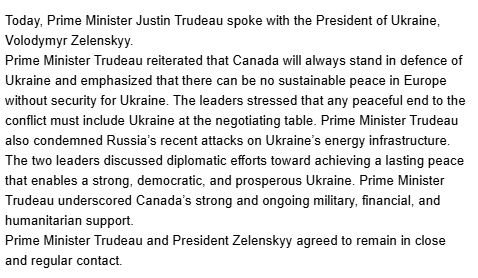
The Canadian Government has also released an official statement reiterating our nation’s support for Ukraine’s full territorial integrity:
Canada’s support for Ukraine has not gone unnoticed by Ukrainian President Zelenskyy, who expressed his appreciation on Twitter:
Now, some will understandably argue that Canada should turn in on itself and retrench. Facing external threats, and facing the potential loss of our security guarantee from the United States, many would want Canada to concentrate only on ourselves. Such an approach would entail looking at Ukraine and saying “This isn’t our problem.”
However, this approach would be an error.
It would be an error from an ethical perspective.
Abandoning Ukraine to Russia would mean abandoning tens of millions of people to Russian tyranny. It would mean abandoning our oft-stated commitment to supporting Ukraine – a commitment that some of our allies (including the United Kingdom and the United States) have put into writing. Abandoning Ukraine would mean showing that Canada’s word means nothing.
It would also be an error from a self-interested perspective.
From a pure power perspective, a Russia that conquers Ukraine would be a much more powerful enemy down the road. Russia would add tens of millions more people to its population, would brutally conscript Ukrainian men into the Russian army, would benefit from Ukrainian military innovations, and would take over Ukraine’s substantial military-industrial complex. That would make the world more dangerous for Canada. By contrast, a world where Ukraine defeats Russia – or at least gets favourable terms in a peace deal – is a world where Russia is weaker, and thus a world where Canada is more secure.
There is another self-interested reason for Canada to support Ukraine:
If we expect Europe to defend our territorial integrity in the future, we must stand with Europe now.
European nations are increasingly realizing that Ukraine’s survival is an existential issue for them. If the US, Russia, and China seek to carve up the world in some sort of ‘grand imperial conference’, much of the European Union would be at risk, as would Canada.
Canada needs friends
If the United States were to move beyond ‘economic force’ and start threatening the use of military force against Canada, or if the U.S. partnered with Russia in the Arctic to extract resources from Canadian territory, we would need our friends to speak out on our behalf.
If countries like France, the United Kingdom, Germany, Poland, Italy, and others were to speak up in defence of Canada’s territorial integrity – including showing a willingness to station troops in Canada (something that would be consistent with our membership in NATO) – it would go a long way toward dissuading U.S. aggression.
Canada could help stave off future U.S. moves against our territorial integrity by securing mutual defence pacts with our European allies, to buttress the NATO commitment already in place.
Public opinion in Europe is already indicating strong support for standing by Ukraine – even if doing so jeopardizes ties with the United States:
This sets a precedent for European nations aiding Canada even in the face of U.S. opposition.
However, if we expect our allies in Europe to answer Canada’s call in the future, we must answer their call now.
That’s why as we ramp up our military production, we should continue giving 155mm ammunition and air defence assistance to Ukraine. This demonstration of real commitment and ‘skin-in-the-game’ is what builds the credibility that heightens the chance of receiving a positive response if we ask for European help down the line.
As has been said before, we can’t control what the United States does, but we can control how we respond. The U.S. may choose to sell out its allies and side with Russia. It may choose to step back from the world. It may choose to threaten Canada.
As horrible as those prospects may be, Canada can – and must – choose a different path.
We must stand with Ukraine and stand with our European allies, while at the same time building up our economic self-sufficiency and rapidly rearming for a more dangerous world.
This is a decisive moment in Canadian history, a moment when doing the right thing and doing the self-interested thing is aligned.
Standing with Ukraine now makes Canada more secure.
And our future survival as a nation may depend on it.
Spencer Fernando
Photo – Twitter
On Patreon, I create more content for a strong and sovereign Canada.
Prefer a one-time contribution? You can give via PayPal.