Why did Canada’s victory over the United States in the 4 Nations Face-Off matter so much to this country? Because it was an expression of our nationhood at a time when that nationhood is under attack. It was a moment of defiance at a time when defiance is becoming increasingly necessary.
The 4 Nations Face-Off wasn’t intended to generate a surge of nationalism in Canada.
It was meant to be a chance for the NHL to get some attention with an experimental mid-season exhibition tournament.
But that’s not how it turned out.
Rather than being a distraction from the NHL regular season, the 4 Nations Face-Off turned out to be the main event, one of the most watched and most consequential tournaments in quite some time.
The championship game was the most watched non-Olympic hockey game in history in the United States, and pulled in huge ratings in Canada (especially as a percentage of our population) with 6.95 million viewers in Canada, and 9.52 million viewers in the United States:
The game became heavily politicized, with the United States taunting Canada about becoming the ’51st State’, taunts that are taking on an increasingly sinister dimension amid America’s apparent realignment towards Russia and away from their traditional allies like Canada and the European Union.
And it should be noted that those taunts continue – including from the official Twitter account of the U.S. Republican Party:
A symbolic victory
For many Canadians, this is a time of profound distress. Our economy and our sovereignty are under attack from a country that we long assumed would be a permanent friend and ally. Europeans are going through a similar feeling, but they at least have other neighbours to fall back on.
Not so for Canada.
If the U.S. becomes a hostile or antagonistic nation, Canada instantly shifts from one of the world’s most secure nations to one of the most endangered.
In the face of this head-snapping shift, a symbolic victory over the United States – in an American arena no less – is a profound symbolic victory.
We didn’t secure our sovereignty in the long term.
We didn’t shift the balance of power in our favour.
We didn’t stop tariff threats or dissuade future assaults on our sovereignty.
But a group of Canadians wearing our colours, with our country’s name on their jerseys, went into opposing territory and won a game that symbolized national pride for both countries.
They did so after Canada was repeatedly insulted by the United States, and after the U.S. President further politicized the game by calling up the U.S. team before the match.
The win was thus a symbol of Canadian strength.
And that means something.
Canadian unity
Because Canada has been secure for so long, we have been able to view national unity as optional. Until now, the greatest threats to our ongoing existence as a unified country have come from within, particularly from the Quebec separatist movement which almost broke the country in 1995.
We had the luxury of indulging in aggressive political debates and treating our political opponents as enemies.
We don’t have that luxury anymore.
For the first time in a long time, Canada faces a potentially existential external threat – an aggressive United States that may want to seize our country and wipe out our status as an independent nation.
Unsurprisingly, this is causing Canadians to reassess how we view our fellow Citizens. While domestic political debates are still important, whether a Canadian is a Conservative, Liberal, New Democrat, Green, or Independent matters less and less the more our country faces threats to our sovereignty.
As a result, Canadians are looking for and longing for ways to express our growing sense of unity. Cheering together for Team Canada against the United States provided a perfect way to share in a sense of being Canadian.
And that’s what we saw last night after Canada won. For a moment, none of us were left-wing, centrist, or right-wing. Where we or our ancestors came from didn’t matter. All that mattered was that we shared in a sense of victory watching our team defeat the U.S.
David vs Goliath
There’s more than Canadian national pride at play here.
There is also the deeply ingrained feeling of cheering for the underdog.
It’s why the story of David vs Goliath resonates so strongly.
And it doesn’t get much more David vs Goliath than Canada vs the United States.
These are very deep aspects of being human that are being activated within us. In part, this is why there has also been such a visceral reaction to Donald Trump blaming Ukrainian President Volodymyr Zelenskyy for Vladimir Putin’s invasion of Ukraine. It looks like – and is – kicking someone when they are down, and it’s siding with the bullying aggressor over the innocent victim.
Trump’s threats towards Canada are seen by people around the world similarly, which is why a rising level of anger and disgust is being directed towards the current U.S. Administration by people across the globe – including many principled conservatives who have long been fans of the United States.
And so, there is something deeply satisfying in seeing David beat Goliath, seeing the victim overcome the bully. For a brief moment, it helps the world make sense and restores our sense that right and wrong still matter.
Many of us have needed that.
A Moment of Canadian Defiance
Above all else, Canada’s victory over the U.S. was a moment of defiance.
History is full of moments when people stood up to a much more powerful aggressor, knowing they would pay a serious price for it, even knowing they could potentially lose.
We are seeing this right now in Ukraine:
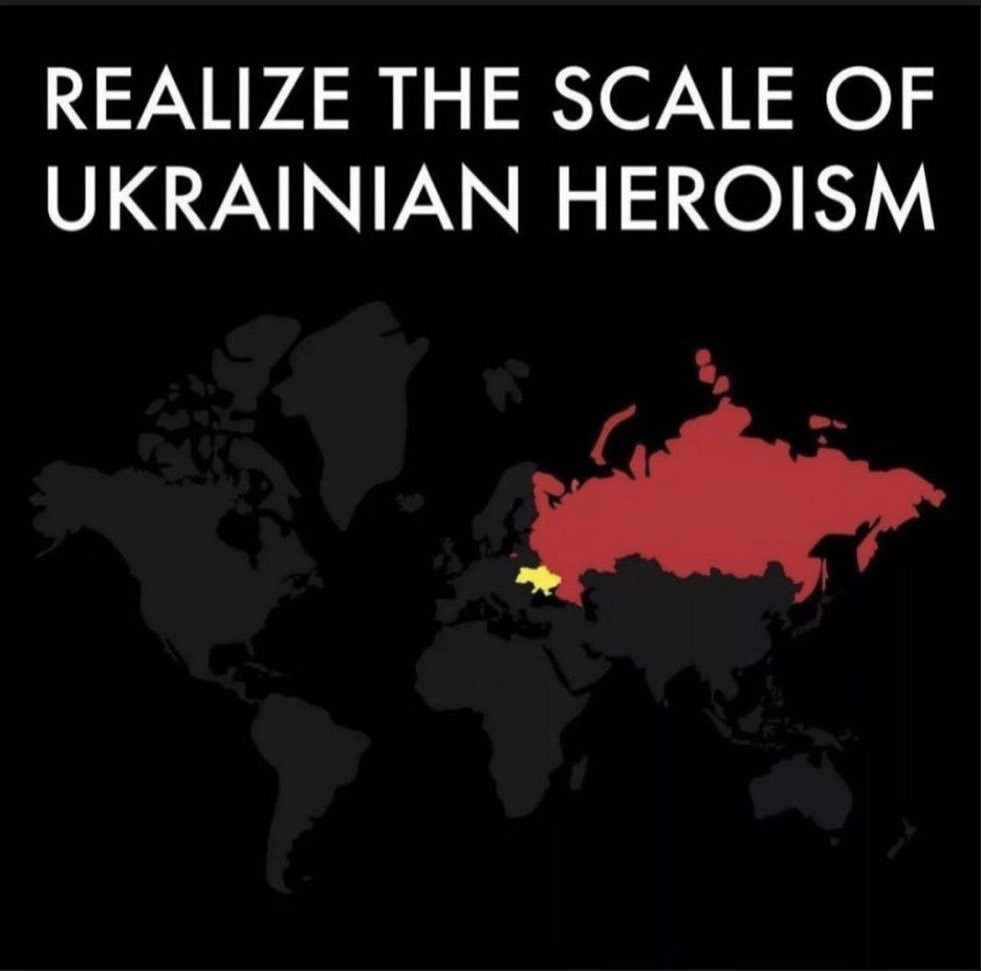
Obviously, a hockey game is not a defensive war.
And Canada is not at the point of being invaded by the United States. Such a scenario remains unlikely (though less impossible than we would have thought a few months ago as the world order rapidly crumbles).
Yet, as former Prime Minister Stephen Harper noted, Canadians must be prepared to pay a heavy price to preserve our sovereignty:
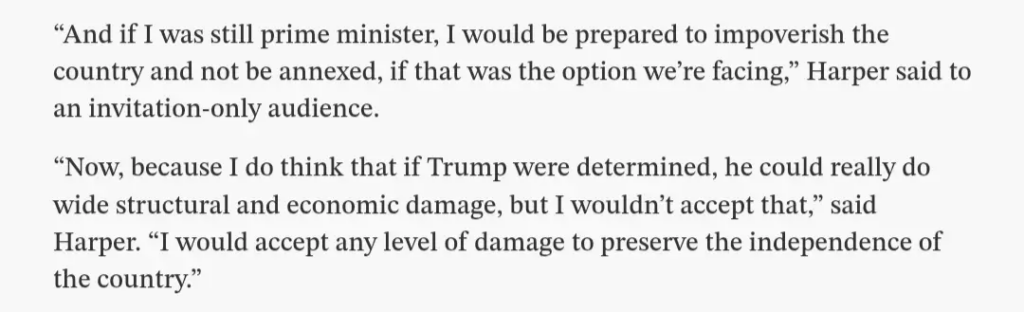
This is why an act of defiance – even a symbolic one in a hockey game – matters so much.
It is dawning on more and more Canadians that such acts of defiance are going to have to become much more common – and much more serious – in the months and years ahead. If the U.S. President is indeed hell-bent on wrecking our economy to try and force us into giving up our independence, then Canada is going to have to become a defiant nation in a myriad of ways.
Turning symbolism into action
Building Canada was difficult.
This land was not easy to tame.
Surviving – and then thriving – in a frigid land took strength, determination, and resolve.
And for those who came here from abroad, abandoning everything familiar and starting over in a new land wasn’t easy either. It took courage and a sense of optimism that obstacles could be overcome.
Our ancestors turned to stories of heroism and defiance to find the strength to make it through.
And so must we.
So, in one respect, the 4-Nations Face-Off was just a hockey game.
But in another respect, it was much more.
It was a new chapter in the story of Canada, a chapter we can now turn to for strength in the difficult times ahead.
Our spirit of defiance must now drive rapid action to rebuild our military, become more self-reliant, and deepen our ties with allied nations.
We must turn symbolism into action and do what it takes to make sure our country survives.
Spencer Fernando
Photo – Twitter
On Patreon, I create more content for a strong and sovereign Canada.
Prefer a one-time contribution? You can give via PayPal.