With the United States showing it cannot be trusted at the moment, Canada should reach out to European and South Korean defence companies to purchase new equipment and get military production facilities built on Canadian soil.
Every business depends on trust.
If you don’t trust a company, you’re unlikely to buy anything from them, unless you have no choice.
Trust is tough to gain, but easy to lose.
Trust built up over decades can be lost in weeks, or even days.
And even when there’s a good faith effort to rebuild lost trust, the process is long and arduous.
This is a lesson the U.S. defence industry is about to learn the hard way.
For defence companies, the worst possible thing a national government can do is leave other nations unsure whether the weapons and systems they purchased will be usable when it matters most.
Given a choice between selling substandard weapons that can be relied upon, or advanced weapons that can’t be relied upon, any rational defence company would prefer the former. After all, a trusting business relationship can be built through the sale of substandard weapons. It is better to have a substandard self-propelled artillery gun that can still shoot at the enemy than an advanced rocket-propelled artillery system with its targeting array shut down on a whim.
For decades, the U.S. defence industry has provided the best of both worlds:
Advanced weapons that can be relied upon.
The U.S. defence industry got a significant boost following Russia’s invasion of Ukraine, when Russian weapons proved to be far less effective than many presumed, and when even 30+ year-old U.S. weapons proved to be more effective than comparative Russian systems.
Many countries started to ask themselves why they should buy new Russian weapons when even old U.S. weapons performed better.
And so, having built up decades of trust as the “Arsenal of Democracy,” the U.S. defence industry was even better positioned for the future.
Now, that’s all being wiped out.
All the accumulated trust is evaporating as the U.S. President Donald Trump realigns America away from its traditional democratic allies and towards authoritarian states like Russia.
As part of this realignment, Trump has halted intelligence sharing with Ukraine (making it easier for Russia to strike and reducing the effectiveness of U.S.-provided air defence and artillery systems), and halted all military aid to Ukraine.
Here’s a good explainer on the impact this will have:
“A significant part of the American aid has been to supply Ukraine with air defense missiles, which not only protect Kyiv’s military positions but also civilians in cities, which have been targeted by the Russian military. It is also crucial in giving Ukraine artillery, which it has used to slow Russian advances over the winter. And it has been central in training the Ukrainians how to use the equipment, maintaining and repairing it and providing transport.
Europe could pick up some of the slack, but it will be nearly impossible to do so completely, Horowitz said. And while moves to remove American support would not cause issues immediately, in time “they will become quite crippling,” he added.
Likewise, though Ukraine receives some ammunition from Europe, “uncertainty about future U.S. aid shipments could lead Ukraine to begin rationing ammunition,” said Rob Lee, a senior fellow at the Foreign Policy Research Institute, a Philadelphia-based think tank.
Ultimately that “will lead to higher casualties for Ukrainian forces,” he told NBC News.
In the skies, Ukraine relies on the United States to supply the interceptor missiles for its Patriot air defense systems. “Without them, Ukraine will have more difficultly protecting its cities from Russian missile strikes,” Lee said.
It also has no effective replacement for the multiple guided missiles, which the U.S. supplies for its High Mobility Artillery Rocket System, or HIMARS, which have been used to great effect against Russia.”
With Trump’s decision to halt support for Ukraine already sending shockwaves throughout Europe, two top U.S. officials – Elon Musk and Marco Rubio – also picked an odd fight with Poland – a staunch U.S. ally.
“Secretary of State Marco Rubio and tech billionaire Elon Musk have had a contentious exchange with Polish Foreign Minister Radoslaw Sikorski, in a series of X posts on Sunday over the use of Musk’s Starlink satellite system in Ukraine.
In a response to a post from Musk mentioning turning off the system, Sikorski implied that any threats to shut down Starlink would result in a search for other suppliers.
Rubio quickly dismissed the claims that Musk would shut down the system and urged Sikorski to be grateful.
The trio went back and forth in an exchange of posts on X that ended with Musk calling Sikorski “small man”.
Starlink’s system is part of SpaceX’s mission to provide high-speed internet to remote and underserved areas – like war zones – around the world.
Sunday’s exchange started when Musk posted that Starlink was the “backbone of the Ukrainian army”.
“Their entire front line would collapse if I turned it off,” he wrote.
Sikorski then responded to Musk’s post, saying that Poland was paying for the service.
“Starlinks for Ukraine are paid for by the Polish Digitization Ministry at the cost of about $50 million per year,” Sikorski wrote. “The ethics of threatening the victim of aggression apart, if SpaceX proves to be an unreliable provider we will be forced to look for other suppliers.”
Sikorski’s post caused Rubio to chime in, writing that the Polish foreign minister was “just making things up”.
“No-one has made any threats about cutting Ukraine off from Starlink,” Rubio wrote.
“And say thank you because without Starlink Ukraine would have lost this war long ago and Russians would be on the border with Poland right now,” he added.
Musk later responded to Sikorski’s post calling him a “small man”.
“Be quiet, small man. You pay a tiny fraction of the cost. And there is no substitute for Starlink,” Musk wrote.”
After receiving significant blowback – likely from Starlink shareholders wondering how they will sell future systems if nobody trusts the company – Musk attempted to do some damage control and claim Starlink would never be shut off:
“Exactly!
To be extremely clear, no matter how much I disagree with the Ukraine policy, Starlink will never turn off its terminals.
I am simply stating that, without Starlink, the Ukrainian lines would collapse, as the Russians can jam all other communications!
We would never do such a thing or use it as a bargaining chip.”
The growing instability demonstrated by top U.S. officials is causing some countries – including perceived Musk-Trump allies like Italy – to ‘reconsider’ deeper reliance on the U.S.:
“The Italian government is having growing doubts about closing a €1.5 billion (US$1.6 billion) deal with Elon Musk’s Starlink in light of the U.S. pullback from commitments to European security, people familiar with the matter said.
Possible alternatives to Starlink for secure satellite-based communications to the government include Eutelsat Communications SA, according to the people, who asked not to be identified because the talks are confidential. Musk, a close ally of United States President Donald Trump, is also seen as an unreliable partner by some in Meloni’s administration, they said.”
European militaries are also now asking themselves if weapons they bought from the U.S. could be shut off:
“Can the US switch off Europe’s weapons?
The answer: Absolutely YES!
European militaries rely on US technology for maintenance, software updates, and spare parts. If Washington cuts support, key systems like fighter jets, missile defenses, and drones could become inoperative.
Richard Aboulafia warns of potential US “kill switches” in European weapons:
“If you postulate the existence of something that can be done with a little bit of software code, it exists.”
55% of Europe’s defense imports (2019-2023) came from the US—a sharp rise from 35% in the previous five years (SIPRI).
Countries like Denmark, Norway, the UK, and Switzerland rely on US-made F-35s for air defense. The F-35 requires constant software updates via ALIS, soon to be replaced by Odin.
Sash Tusa warns:
“If the US stops updates, the equipment stops working—if not instantly, then very, very quickly.”
Source: FT”
Remember, Italy is currently governed by a very right-wing, pro-America administration. Poland is the most pro-America country in Europe. So, if even Italy and Poland are questioning America’s dependability, just think of how everyone else is feeling.
America is sending a clear message:
Your weapons could be rendered useless or less effective on a whim.
This inability to trust a product purchased in a fair transaction would be disastrous in any case, yet it’s especially disastrous when the product in question is military equipment.
If your nation purchases military equipment and it gets shut off when it’s needed most, your military personnel will die. Your country will be weakened. Your nation could even be lost. The stakes are as high as possible.
Thus, it’s time for Canada to look elsewhere.
Europe & South Korea
As the United States distances itself from the rest of the free world, we are seeing a growing understanding in Europe and Asia – particularly in South Korea – of the need for alternatives to American weapons.
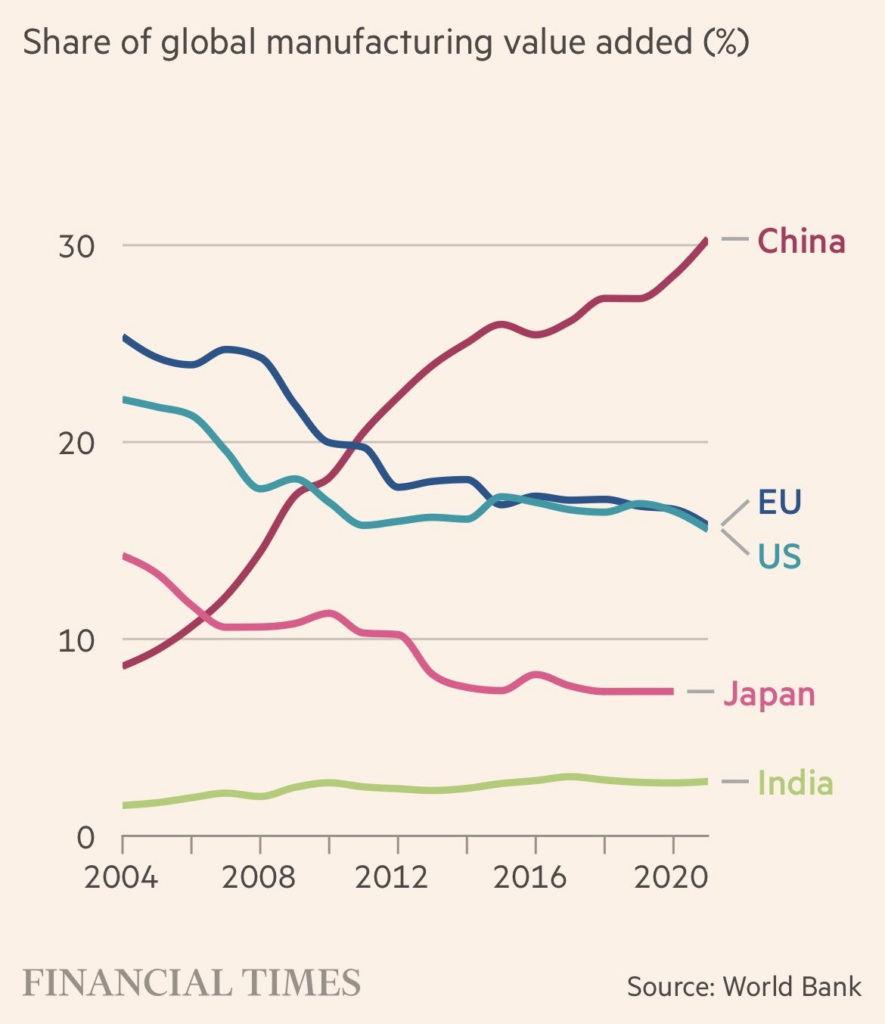
While America is a formidable military industrial power, Canada, the European Union, the United Kingdom, and South Korea combined form a comparable economic zone, possess a larger population, and have more manufacturing capacity.
As you can see in the chart below, the EU & US have relatively comparable manufacturing output, meaning when you combine Canada, the United Kingdom, and South Korea to the EU figure, America lags:
Europe also possess significant latent manufacturing capacity, given their lower debt levels, and lower average borrowing costs compared to the United States. Many European nations – particularly Germany and France – produce world-class weapons. Their problem is that they don’t produce enough of them. That problem can be addressed by countries like Canada placing some big orders.
South Korea is in a different position, given their need to always be war-ready due to the threat from North Korea. South Korea produces affordable high quality weapons, and they are already reaching out to Canada:
“South Korea is pitching Canada on a host of new military equipment deals, pointing out that the Asian nation can not only deliver defence systems quickly but that it is a trustworthy ally.
The push comes as recent actions by U.S. President Donald Trump, which include cutting Ukraine off of military supplies and threatening to annex Canada, have American allies around the world reconsidering their security arrangements.”
And in response to fears of U.S. unreliability, South Korea is emphasizing that Canada would have full access to the technology that ensures purchased systems operate effectively:
“Maintenance facilities would be established in Canada, and unlike with U.S. weapon systems, the South Koreans would provide Canada with total access to the onboard technology. In addition, Hanwha has already been signing alliances with Canadian firms for potential work on the proposal.”
The fact that South Korean defence firms pitch reliability as a key benefit indicates how rapidly America has hemorrhaged trust with its closest allies.
Canada must internalize this lesson. As we rebuild our military (something that is now an existential imperative), we must not rely upon the same nation that is threatening us. Buying American would be foolish and naive at this time. Instead, we need to look to Europe and South Korea.
In an upcoming article, I will go into more detail regarding the specific companies and weapon systems Canada should purchase from Europe and South Korea, and how we can rapidly get factories set up on Canadian soil to ensure we build the weapons we need here in our own country.
Spencer Fernando
Photo – YouTube
Subscribe to my Substack, where I create more content for a strong and sovereign Canada.
Prefer a one-time contribution? You can give via PayPal.