Erratic tariff moves and contradictory exemptions have eroded Washington’s credibility without delivering strategic gains.
It is comforting to believe those in power have a plan. Even if we disagree with that plan, there is reassurance in the idea that a group of competent people are taking actions based on a coherent and (at least somewhat) reality-based intellectual framework.
By contrast, it is deeply unsettling to consider that those in power are making it up as they go along. If world events are shaped by people who are ‘winging it,’ the implications are dire.
Unfortunately, we must conclude that U.S. President Donald Trump’s escalating tariff war exemplifies the latter.
Markets Push Back Against Trade Instability
Donald Trump has a problem:
His view of trade (falsely believing a trade deficit is a loss) is incompatible with reality. Yet, he feels compelled to impose his view by using tariffs to eliminate trade deficits.
However, every time he tries to impose tariffs, the market rebels. Every time he moves away from tariffs, the market celebrates. And while he thought he could stare down the stock market, the bond market was a different story.
After announcing a 90-day pause on his ‘liberation day’ tariffs, Trump noted that “the bond market is very tricky. I was watching it,” adding that people were “getting yippy.” Rising US bond yields indicated growing concern about the reliability of the United States and risked driving up U.S. borrowing costs.
Unstable trade policies – launching a global trade war based upon a deeply flawed tariff logic – are eroding confidence in the United States. Top U.S. allies and partners – including Canada – now increasingly view the United States as untrustworthy.
While the tariff pause brought some relief, confidence was again shaken when the U.S. President announced tariffs on China would rise to 145%. This announcement was followed by more incoherence. The White House told China not to retaliate, then reportedly asked China to publicly ask for a phone call, in what appeared to be an effort to help Trump save face. China did not ask for a phone call, and instead promptly announced retaliatory tariffs on the U.S. of 125%.
Trump then backed down, announcing exemptions on a wide range of products from China:
Chinese-made smartphones, computers, semiconductors, solar cells, flat screen TVs, SSDs, flash drives, and memory cards are now exempt not only from the 145% tariff on China, but from the 10% global ‘reciprocal’ tariff.
Note, Trump did not gain any concessions with this move.
Deepening Contradictions
As a result of these latest exemptions, some deep contradictions have emerged.
As noted by data scientist Armand Domalewski, a frequent commentator on U.S. trade dynamics, a computer made in China will be free from tariffs, while a computer made in the United States with parts from China will be hit with tariffs on individual components:
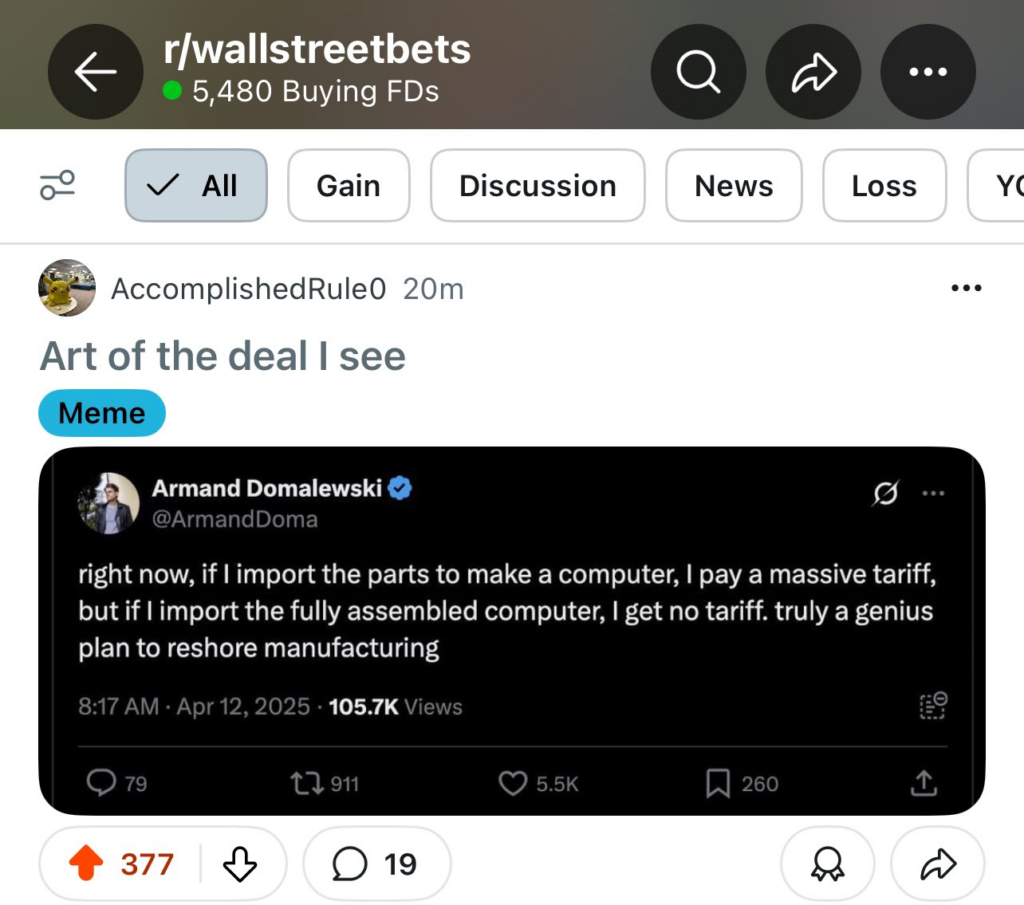
Such a policy hurts the very domestic U.S. producers the Trump Administration claims to want to help.
Further, many Chinese-made products are still subject to tariffs, including products often purchased by low-income Americans and products used by American small and medium businesses. Yet, exemptions have been notably directed towards large technology firms that possess significant lobbying power.
In this environment, long-term planning has become nearly impossible. Nobody knows what to expect next, and Trump often appears to be negotiating against himself as he tries to bluff his way into a dominant position through the imposition of large-scale tariffs that markets refuse to abide.
And no matter how much Donald Trump may wish for the markets to love his tariffs, reality won’t cooperate with his view of trade, and bluster is unable to bridge the gap.
There is no indication of deeper thought here other than ‘trade deficits are bad’ and ‘tariffs are good,’ and thus there is little strategic coherence in Trump’s approach to trade policy.
Ultimately, Trump’s trade approach, while long on rhetorical force, is short on the consistency, foresight, and policy grounding necessary to inspire confidence among market participants or international partners.
In a global economy increasingly shaped by credibility and cooperation, improvisational nationalism is not a substitute for strategy.
Spencer Fernando
Photo – YouTube
On Patreon, I create more content for a strong and sovereign Canada.
Prefer a one-time contribution? You can give via PayPal.